The Conversation (0)

Dart Mining NL (ASX:DTM) (“Dart Mining” or “the Company”) has received more positive results from the Phase 2 diamond drilling within the company’s 100% owned Rushworth Gold tenement package.
Results continue to highlight the prospectivity of the Historic Rushworth Goldfield. The ongoing success of the drilling validates our mineral systems model and supports the company’s ongoing exploration strategy across a field showing very shallow historic development and very limited previous deeper drill testing.
Highlights include:
Chairman, James Chirnside commented:
“Dart’s drilling activities at Rushworth continue to be successful. By leveraging our advanced mineral systems model and in-depth structural analysis, we have effectively pinpointed highly prospective targets. Each drill hole has consistently returned positive gold grades, reinforcing the potential of these identified structures. We remain committed to further advancing our exploration efforts and are eager to further develop the project’s apparent opportunities”
Drilling Results Discussion
The first results from the Phase 2 program returned up to 0.24m @ 8.8g/t Au, from 56.2m downhole from hole SWDD004 (Shellback Reef) from within a broad zone of sulphide mineralisation returning 7.1m @ 0.75g/t Au from 50.8m - (DTM ASX 23rd July 2024) in the Star of the West area. Results from Phase 2 continue to show high grade results within the targeted Shellback Reef structures with hole SWDD005 showing up to 0.4m @ 8.4g/t Au from 19.9m downhole.
SWDD005 intersected a steep south dipping thrust fault structure surrounded by apparent sulphide mineralisation forming a halo of gold results (1.2m @ 4.5g/t Au from 19.9m). Mineralisation was observed in the drill core as weathered sulphide pitting with surrounding iron staining, surrounding a quartz reef structure in sandstone lithologies. In line with the results from hole SWDD004, SWDD005 also intersected at least two zones of gold mineralisation with the weak lower zone showing up to 0.5m @ 1.1g/t from 94.9m downhole (Figure 3). Lidar interpretation to the west of holes SWDD004 & SWDD005 illustrates a broad area of extensive surface pitting (Figure 2). SWDD006 results remain outstanding, however given the pleasing results from initial drilling into the Shellback Reef to date, further drill testing appears to be clearly warranted in the coming months
The presence of gold rich sulphide mineralisation surrounding thrust faulting is a consistent observation and supports the company’s interpretation that the mineralising fluid and deposition environment of the Rushworth region is similar, if not the same, as nearby Central Victorian gold regions of Fosterville and Costerfield.
Rushworth Phase 3 drilling
Drilling has commenced at the Phoenix Reef prospect with 385m of a planned 1100m drill program completed to the 7th of August 2024. The Phoenix group of historic workings is one of the more extensive for the field but still only shows historic workings to some 50m below surface. Drilling is targeting interpreted deeper repeating thrust faulting below the historic stacked Phoenix, Fletchers and Appleton’s Reefs exploited for over 1000m of strike from surface.
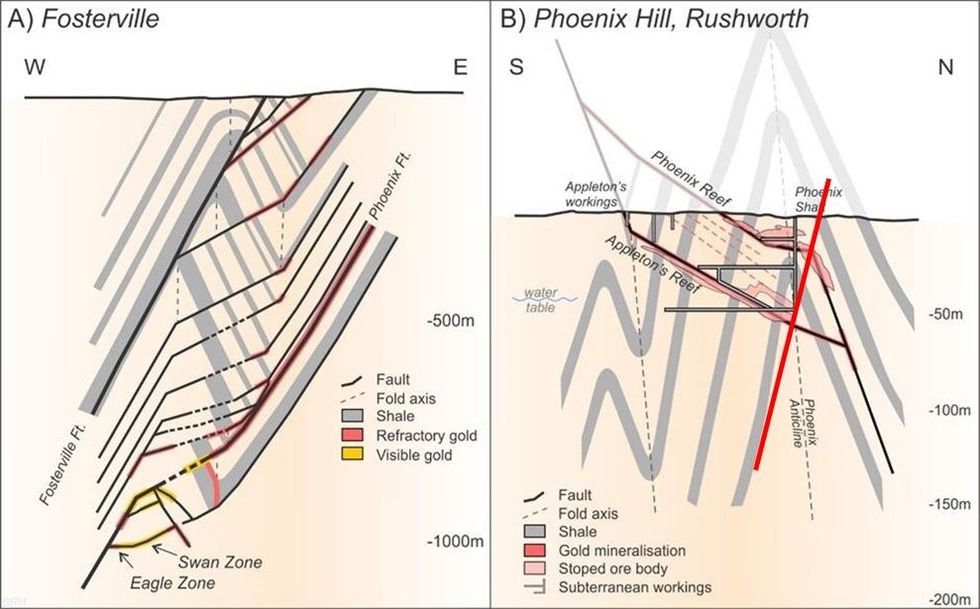 Figure 1: Phoenix Hill cross-section compiled from geological mapping completed by Jones & Turnbull (2014) and Boucher (2016). Figure modified from Dart Mining ASX November 2020. Planned drilling location shown in Red.
Rushworth Structural Architecture
The Rushworth goldfield is focused along a series of regional East-West orientated anticline folds which host shallow historic gold workings along a cumulative strike length of approximately 14km (Figure 2). The major limbs of the anticline also exhibit smaller scale parasitic folding and various changes in bedding strike and dip. Significant North-South orientated structures crosscut and offset East-West bedding and fold hinges along the length of the field.
The East-West orientation of the field is unusual for Victorian Goldfields, which usually trend North-South, due to the added structural complexity of the Rushworth Region being highly influenced by the Lachlan Orocline formation and induced North-South crustal shortening through subduction rollback.
Mineralisation historically exploited at Rushworth concentrated on alluvial mining before focus shifted to the hard rock source. Mineralisation is dominated by free gold located in quartz veins hosted within sandstone and shale lithologies.
Click here for the full ASX Release
This article includes content from Dart Mining NL, licensed for the purpose of publishing on Investing News Australia. This article does not constitute financial product advice. It is your responsibility to perform proper due diligence before acting upon any information provided here. Please refer to our full disclaimer here.