The Conversation (0)

2026 ASCO Annual Meeting, May 29-June 2, 2026, at McCormick Place, Chicago, Illinois
briacell therapeutics corp. (Nasdaq: BCTX, BCTXL) (TSX: BCT) ("BriaCell" or the "Company"), a clinical-stage biotechnology company developing novel immunotherapies to transform cancer care, announces positive clinical data from three clinical data poster presentations at the 2026 ASCO Annual Meeting, taking place May 29-June 2, 2026 at McCormick Place, Chicago, Illinois. The presentations will include two poster presentations featuring data from BriaCell's ongoing pivotal Phase 3 study of Bria-IMT plus an immune checkpoint inhibitor (ClinicalTrials.gov identifier: NCT06072612) and one poster highlighting further analyses of Phase 2 data.
"Late-stage metastatic breast cancer (MBC) is often associated with a poor prognosis and very short survival rates," stated Saranya Chumsri, MD, principal investigator in the Phase 3 study of Bria-IMT+CPI, and Professor of Oncology at Mayo Clinic Florida. "We are pleased to report Phase 2 study median overall survival rates as high as 16.6 months and a high rate of long-term survival in our late-stage MBC patients including in patients resistant to multiple prior therapies."
"BriaCell's Phase 3 data are highly encouraging because they address one of the key challenges in treating late-stage breast cancer patients: delivering clinical benefit while limiting toxicity that can lead to voluntary treatment discontinuation," stated Adam M. Brufsky, MD, PhD, FACP, Professor of Medicine at the University of Pittsburgh School of Medicine and Medical Director of the Magee-Women's Cancer Program.
"We are increasingly optimistic with the early quality of life and biomarker data from our ongoing pivotal Phase 3 Bria-ABC trial demonstrating sustained clinical activity in patients with advanced MBC who did not respond to multiple prior treatments," noted William V. Williams, MD, BriaCell's President & CEO.
The details of the presentations are listed below.
Abstract Title: Survival with Bria-IMT + CPI in advanced metastatic breast cancer at 12 and 24 months.
Session Type/Title: Poster Session - Breast Cancer—Metastatic
Poster Board: 222
Date and Time: June 1, 2026, 1:30 PM-4:30 PM CDT
Clinical Data: 32 Phase 2 Bria-IMT patients were randomized to receive immune checkpoint inhibitor (CPI) in the first cycle or delayed to the second cycle. Two Bria-IMT formulations were also evaluated. Patients had median age of 61 (range 41-80) and had received median 6 prior therapies (range 2-13). Treatment was well tolerated with injection site reactions, mostly mild in severity, the most frequent side. The clinical benefit rate was 62% overall in long-term survivors. Of patients treated with the Phase 3 formulation, 10 of 21 (48%) survived over a year.
Median overall survival ("OS") was 13.3 months for patients who initiated checkpoint inhibitor ("CPI") therapy in Cycle 1 (as is being done in the Phase 3 Bria-ABC study) versus 7.4 months for those who initiated CPI therapy in Cycle 2 with estimated 12-month and 24-month OS rates being 50% and 25% for initiating CPI in the first cycle. Among patients who developed an immune response, as measured by delayed-type hypersensitivity ("DTH"), median OS was 11.9 months in DTH-positive patients versus 4.7 months in DTH-negative patients, with 48% versus 0% 12-month survival, respectively. Estimated 12-month and 24-month OS rates were 41% and 24%, respectively, for the entire Phase 2 population. For patients treated with the Phase 3 regimen, the median OS was 16.6 months with >55% OS at 1 year and >27% at 2 years (see Figure 1 below. Note that the CPI at C1 and IP w/o IFNγ is the Phase 3 Bria-IMT regimen). There were no treatment-related discontinuations and no unexpected safety signals.
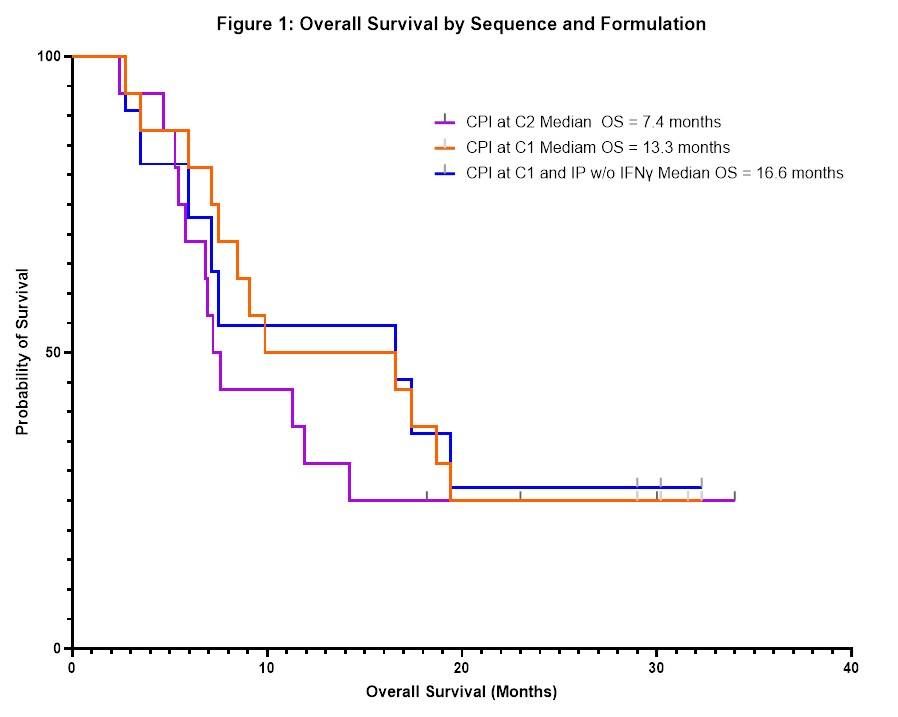
Figure 1: Phase 2 study overall survival by sequence and formulation demonstrating extended OS with CPI at C1 and IP w/o IFNγ (Bria-IMT Phase 3 regimen)
Conclusions: In heavily pretreated MBC patients, Bria-IMT demonstrated an excellent safety profile and the emergence of a long-term survivor cohort. Durable survival rates were observed beyond 12 and 24 months. Differential survival favored the Phase 3 formulation, DTH positivity, lower baseline circulating tumor cell (CTC) levels, and early CPI sequencing. These findings support prospective validation of DTH and CTC as predictive biomarkers for effectiveness of the Bria-IMT regimen and the continued use of the Phase 3 formulation in the ongoing Phase 3 study Bria-ABC. The clinical findings further confirmed the preferred formulation for the ongoing pivotal Phase 3 study.
Abstract Title: Quality of life and treatment tolerability of Bria-IMT + CPI in metastatic breast cancer.
Session Type/Title: Poster Session - Breast Cancer—Metastatic
Poster Board: 221
Date and Time: June 1, 2026, 1:30 PM-4:30 PM CDT
Summary: Heavily pretreated MBC patients in the pivotal Bria-ABC study demonstrated stable global health and key functional domains. Measurements included quality of life (QOL) and time without symptoms or toxicity (TWiST). Blinded data indicated that QOL was preserved in a heavily pretreated population with prior antibody-drug conjugate (ADC), check point inhibitor (CPI), and cyclin-dependent kinase 4/6 (CDK4/6) inhibitor exposure. Clinical data demonstrates meaningful benefits without significant toxicity. Ongoing follow up will further characterize durability of patient-reported outcomes and clinical correlation. Data further supports decentralized care and potential home self-administration of the Bria-IMT+CPI regimen.
Study patients were heavily pretreated, consistent with BriaCell's prior Phase 2 population, with a median of 6 prior systemic therapies (range: 2–14), including prior ADCs in 84%, CPIs in 27%, and CDK4/6 inhibitors in 61%. Blinded Phase 3 data suggest sustained quality of life despite advanced disease and poor prognostic characteristics. TWiST analysis demonstrated meaningful time alive without disease symptoms or significant treatment-related toxicity, supporting a favorable benefit-risk profile.
Abstract Title: Monitoring blood-based biomarkers as early predictors of progression-free survival in a randomized Bria-ABC Phase 3 trial for advanced metastatic breast cancer: An ongoing analysis.
Session Type/Title: Poster Session - Developmental Therapeutics—Immunotherapy
Poster Board: 442
Date and Time: May 30, 2026, 1:30 PM-4:30 PM CDT
Summary: In an ongoing analysis of heavily treated MBC patients, we observed that in the entire blinded population, 65% of patients had stability/drop in Cancer-Associated Macrophage-Like cells (CAMLs) and this significantly correlated with better progression free survival (PFS).
Results:
In this ongoing blinded analysis of heavily pretreated metastatic breast cancer patients, stable or decreased CAML counts from baseline to Cycle 3 were observed in 60% of evaluable patients and significantly correlated with improved PFS. Baseline CTC positivity was associated with more rapid progression. These findings support further evaluation of CAML dynamics as a potential early blood-based biomarker of clinical outcomes in the Phase 3 Bria-ABC study.
Following the presentation, copies of the posters will be available at https://briacell.com/scientific-publications/.
About briacell therapeutics corp.
BriaCell is a clinical-stage biotechnology company that develops novel immunotherapies to transform cancer care. More information is available at https://briacell.com/.
Safe Harbor
This press release contains "forward-looking statements" that are subject to substantial risks and uncertainties. All statements, other than statements of historical fact, contained in this press release are forward-looking statements. Forward-looking statements contained in this press release may be identified by the use of words such as "anticipate," "believe," "contemplate," "could," "estimate," "expect," "intend," "seek," "may," "might," "plan," "potential," "predict," "project," "target," "aim," "should," "will," "would," or the negative of these words or other similar expressions, although not all forward-looking statements contain these words. Forward-looking statements, including those about the presentation of three clinical data posters at the 2026 ASCO Annual Meeting, and the contents of such posters, including final Phase 2 Bria-IMT survival data, quality of life and TWiST analyses from the ongoing Phase 3 study, and biomarker analyses, are based on BriaCell's current expectations and are subject to inherent uncertainties, risks, and assumptions that are difficult to predict. Further, certain forward-looking statements are based on assumptions as to future events that may not prove to be accurate. These and other risks and uncertainties are described more fully under the heading "Risks and Uncertainties" in the Company's most recent Management's Discussion and Analysis, under the heading "Risk Factors" in the Company's most recent Annual Information Form, and under "Risks and Uncertainties" in the Company's other filings with the Canadian securities regulatory authorities and the U.S. Securities and Exchange Commission, all of which are available under the Company's profiles on SEDAR+ at www.sedarplus.ca and on EDGAR at www.sec.gov. Forward-looking statements contained in this announcement are made as of this date, and briacell therapeutics corp. undertakes no duty to update such information except as required under applicable law.
Neither the Toronto Stock Exchange nor its Regulation Services Provider (as that term is defined in the policies of the Toronto Stock Exchange) accepts responsibility for the adequacy or accuracy of this release.
Contact Information
Company Contact:
William V. Williams, MD
President & CEO
1-888-485-6340
info@briacell.com
Investor Relations Contact:
investors@briacell.com
A photo accompanying this announcement is available at https://www.globenewswire.com/NewsRoom/AttachmentNg/31dfc6cf-bbf0-4255-9a71-332768a478f1

News Provided by GlobeNewswire via QuoteMedia