The Conversation (0)

First drill testing of a large-scale Rossing-style uranium target, along trend of Namibia's giant uranium deposits
ReeXploration Inc. (TSXV: REE) (FSE: K2I0) ("ReeXploration" or the "Company") is pleased to announce the launch of a fully funded uranium drilling program at the Eureka Project in central Namibia. This campaign marks the Company's first drill testing of a large-scale uranium target, 6.5 x 3.5 km in extent, defined through integrated geophysical, geochemical, and geological work. The target is located along trend of Namibia's world renowned "Alaskite Alley", a corridor hosting giant leucogranite-hosted uranium deposits.
The drill campaign will evaluate a range of priority zones distributed across the broader target area, selected on the basis of airborne and ground uranium radiometric responses, uranium-in-soil geochemistry, and interpreted favourable structural and lithological settings. The priority zones all fall within a regional geological setting consistent with leucogranite-hosted uranium systems elsewhere in Namibia's Central Zone, including the Rössing, Husab, and Etango deposits.
The core drilling program is expected to include up to 2,000 metres of drilling across 12 to 15 drill holes, and will be results-driven. Drill holes are designed to test for primary leucogranite-hosted uranium mineralization below the weathering profile.
"The start of drilling at Eureka marks a significant milestone for ReeXploration, representing our first drill program on a large and highly prospective uranium system," said Christopher Drysdale, Interim CEO of ReeXploration. "This initial campaign will evaluate several priority zones and generate critical information to refine our geological understanding and guide future exploration. Importantly, Eureka also hosts confirmed rare earth element mineralization, providing the Company with dual-commodity exposure and long-term strategic optionality. Operating in Namibia, with its proven history of supporting responsible exploration and development, significantly enhances our ability to advance and unlock the full potential of the Eureka Project."
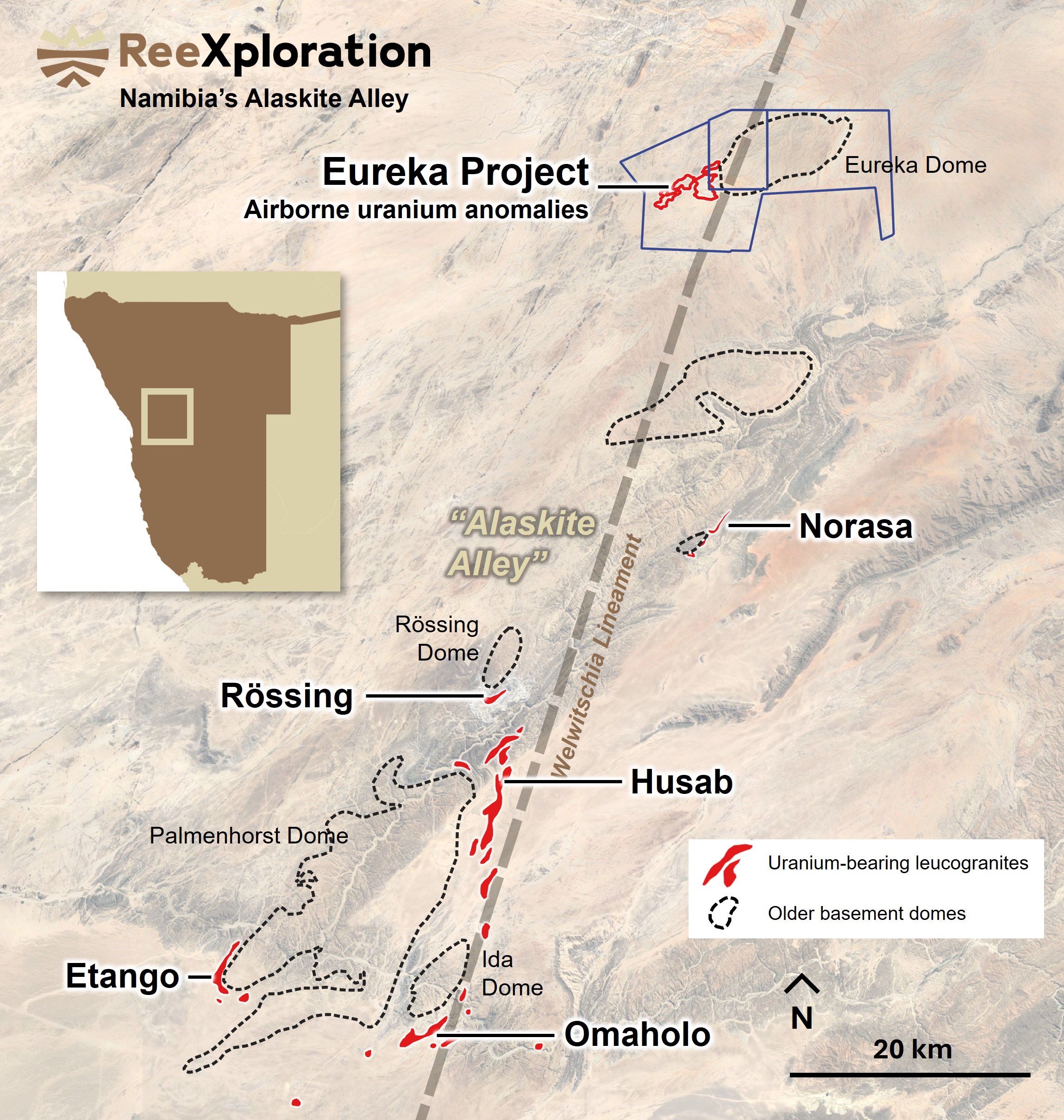
Figure 1: Regional satellite view showing the position of the uranium anomalies southwest of the Eureka Dome, and their proximity to the Welwitschia Lineament and other large uranium deposits in Alaskite Alley.
To view an enhanced version of this graphic, please visit:
https://images.newsfilecorp.com/files/6102/282719_8ad182f6940f097b_001full.jpg
Program Overview and Next Steps
The initial drilling phase (up to 2,000 metres in 12 to 15 drill holes) is designed to provide first-pass testing of the uranium system at depth and to validate the geological model developed from recent radiometric surveys, soil geochemistry, and field mapping.
Priority zones for drill testing have been identified based on coincident:
The zones include occurrences of visible secondary uranium mineralization identified within leucogranites and gypcretes/calcretes.
Drilling will consist of core drill holes designed to confirm the presence, style, and continuity of uranium mineralization at depth, and to improve the Company's understanding of the broader uranium system across the Eureka Project area.
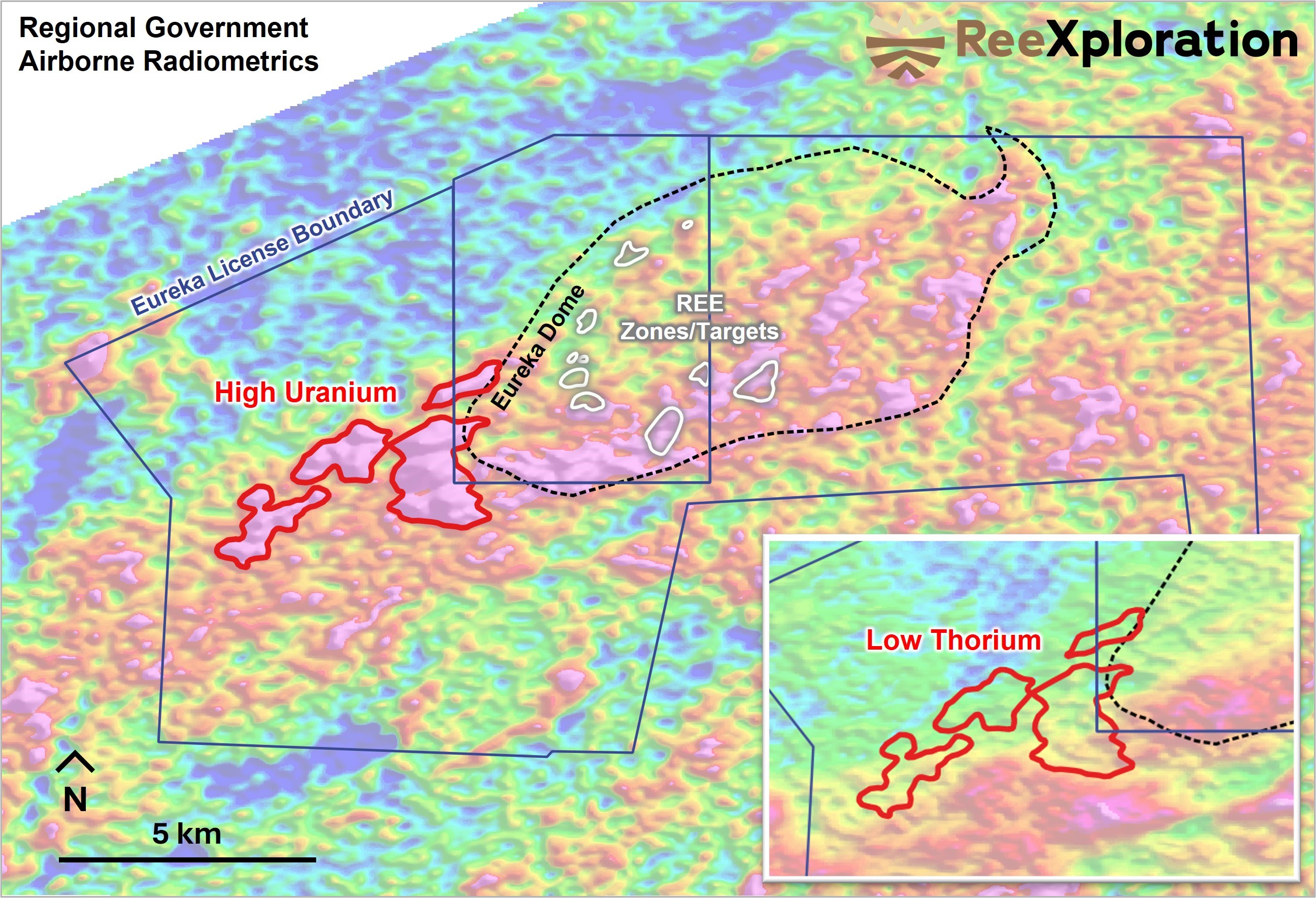
Figure 2: Company license holding showing REE targets within the Eureka Dome, and airborne uranium anomalies (Government Airborne Radiometrics) backdrop. Insert: Thorium radiometric backdrop showing low thorium relative to the uranium anomalies.
To view an enhanced version of this graphic, please visit:
https://images.newsfilecorp.com/files/6102/282719_8ad182f6940f097b_002full.jpg
Qualified Person
Tolene Kruger, BSc. (Hons), M.Sc., is a consulting geologist and has reviewed and approved the scientific and technical information in this news release. Ms. Kruger is registered as Professional Natural Scientist (Pr.Sci.Nat.) with the South African Council for Natural Science Professions (SACNASP, Reg. No.: 148182), and a Qualified Person for the purposes of National Instrument 43-101 - Standards of Disclosure for Mineral Projects. Ms. Kruger is not independent of the Company under NI 43-101.
About ReeXploration Inc.
ReeXploration (TSXV: REE) (FSE: K2I0) is a Canadian exploration company positioned to help meet surging global demand for secure, responsible supplies of critical minerals essential to the clean energy transition, advanced technologies and national defense. The Company's flagship Eureka Project in central Namibia pairs a technically proven rare earth foundation - supported by the production of a clean monazite concentrate - with a newly defined, high-priority uranium target located within one of the world's most established uranium corridors. Together, these commodities provide multi-path discovery potential aligned with accelerating global efforts to diversify critical mineral and nuclear fuel supply. Supported by a Namibia-based technical team and guided by global critical minerals experts, ReeXploration is advancing a disciplined, discovery-led strategy, building a credible, ESG-aligned platform positioned to benefit from the global race to diversify and secure responsible supply chains.
Caution Regarding Forward Looking Information
This press release may contain forward-looking information. This information is based on current expectations and assumptions (including assumptions relating to general economic and market conditions) that are subject to significant risks and uncertainties that are difficult to predict. Actual results may differ materially from results suggested in any forward-looking information. ReeXploration does not assume any obligation to update forward-looking information in this release, or to update the reasons why actual results could differ from those reflected in the forward-looking information unless and until required by securities laws applicable to ReeXploration. Additional information identifying risks and uncertainties is contained in the filings made by ReeXploration with Canadian securities regulators, which filings are available at www.sedarplus.ca.
Neither the TSX Venture Exchange nor its Regulation Services Provider (as that term is defined in policies of the TSX Venture Exchange) accepts responsibility for the adequacy or accuracy of this release.
Further details are available on the Corporation's website at www.rareearthexploration.com or contact Christopher Drysdale, Interim CEO of ReeXploration Inc., at +1 902-334-1949, contact@rareearthexploration.com.

To view the source version of this press release, please visit https://www.newsfilecorp.com/release/282719
News Provided by TMX Newsfile via QuoteMedia