The Conversation (0)

Assay-confirmed shallow mineralization; Sulphide-bearing mafic rocks at depth; Spring 2027 drilling planned
Ni-Co Energy Inc. (TSXV: NICE,OTC:NICLF) ("Ni-Co" or the "Company") reports results from the initial phase of its 2026 diamond drilling campaign at its 100%-owned Kremer nickel-copper-cobalt project in Québec. At Kremer-2, drill hole KR-26-30 intersected 4.60 metres grading 0.59% nickel (Ni), 0.20% copper (Cu) and 0.07% cobalt (Co), including 1.75 metres grading 1.06% Ni, 0.23% Cu and 0.13% Co. Assays from the other 15 holes drilled in 2026 are pending.
The first phase comprised 16 drill holes totalling approximately 3,822 metres and achieved the Company's principal geological objectives: testing near-surface sulphide occurrences and investigating the rocks associated with deeper geophysical targets. Drilling confirmed nickel-copper-cobalt mineralization near surface and encountered several units provisionally logged as mafic and ultramafic rocks at depth, including norite, gabbro-norite and pyroxenite, with visible sulphides in some intervals. These observations strengthen the basis for investigating potential primary magmatic sulphide accumulations subsequently modified by Grenvillian deformation. Borehole electromagnetic (BHEM) surveys have been completed in 11 holes; interpretation is pending.
KR-26-30 drill assay results
Geochemistry results indicate that nickel and cobalt grades generally increase with sulphur content in the sampled core. Table 1 summarizes the reported drill intersections. Repeat analysis of the same core footage has been excluded.
Table 1. KR-26-30 drill-core assay intersections. The "including" intervals overlap; do not add them together.
| Downhole interval | Length | Ni (%) | Cu (%) | Co (%) | S (%) |
| 29.75-34.35 m - main | 4.60 m | 0.59 | 0.20 | 0.07 | 16.02 |
| including 29.75-31.50 m | 1.75 m | 1.06 | 0.23 | 0.13 | 29.15 |
| of which 29.75-30.70 m | 0.95 m | 1.41 | 0.07 | 0.17 | 39.30 |
| including 33.85-34.35 m | 0.50 m | 0.71 | 0.20 | 0.10 | 20.30 |
Grades are length-weighted averages. Reported intervals are downhole lengths; true widths have not yet been determined.
Why the deeper mafic and ultramafic rocks matter
The deeper mafic and ultramafic intersections add an important dimension to the Kremer exploration model. Some sulphide occurrences previously identified at Kremer-1 and Kremer-2 have been interpreted as structurally remobilized. The newly intersected mafic and ultramafic rocks, including units with visible sulphides, raise the possibility that primary magmatic sulphide accumulations remain associated with a parental intrusion. This broader interpretation opens additional exploration targets beyond the known shallow sulphide lenses, although the location, dimensions, grades and continuity of any primary accumulation have not yet been demonstrated.
Hole KR-26-26 (441 metres) intersected several noritic units, including a locally sulphide-bearing interval from approximately 196.5 to 210.8 metres. Hole KR-26-27 (429 metres) intersected gabbro-noritic rocks and a separate sulphide-bearing mafic interval at approximately 323.65 to 329.75 metres. These are preliminary lithological and visual observations, not assayed mineralized widths.
The detailed log of KR-26-30 also records gabbro-norite, leuconorite, noritic rocks and pyroxenite at depth. KR-26-37 and other holes intersected additional mafic units, although sulphide abundance varies substantially among them. Rock classifications remain preliminary pending petrographic and geochemical verification.
The Company will integrate the remaining assays, interpretation of the 11 completed BHEM surveys and ongoing University of Ottawa research to refine its geological model. The size, grade and continuity of any deeper primary sulphide accumulations have not been established.
Remaining exploration potential at Kremer-1, Kremer-2 and Kremer-3
The 2026 holes tested only selected targets at Kremer-2; several shallow and deeper prospects remain untested. Previous selective surface sampling in this area returned nickel-bearing sulphides at multiple locations over approximately two kilometres; 11 of 33 grab samples returned more than 0.5% Ni, including a maximum of 1.21% Ni, as previously disclosed in July 2026. Grab samples are selective and are not necessarily representative of the grade of untested targets.
Kremer-3 remains an untested drill target. At Kremer-1, earlier drilling intersected nickel-copper-cobalt sulphides, while borehole electromagnetic interpretation suggests that some 2023 drill holes may have followed the interpreted dip of the target. Planned follow-up drilling is intended to improve the understanding of geometry and true widths. The approximately eight-kilometre prospective corridor contains distinct targets; continuous mineralization across these areas has not been established.
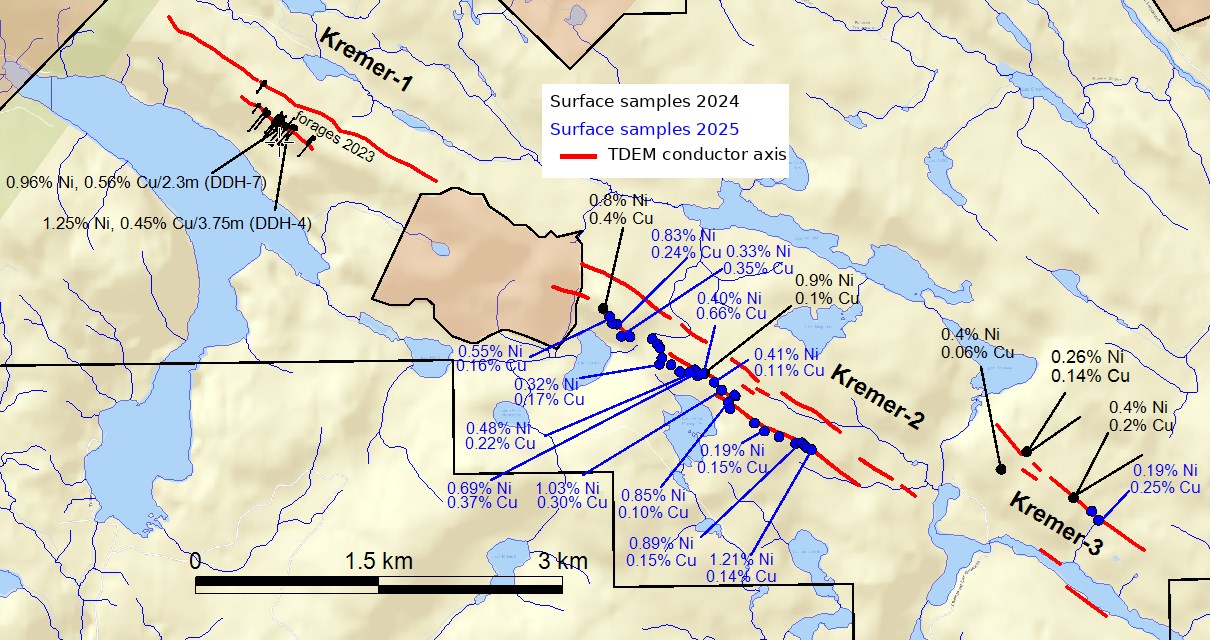
Figure 1. Kremer regional exploration context showing Kremer-1, Kremer-2, Kremer-3, interpreted conductor trends and selected surface sampling. The map does not establish continuous mineralization.
To view an enhanced version of this graphic, please visit:
https://images.newsfilecorp.com/files/12654/324946_42a7650864d97af0_002full.jpg
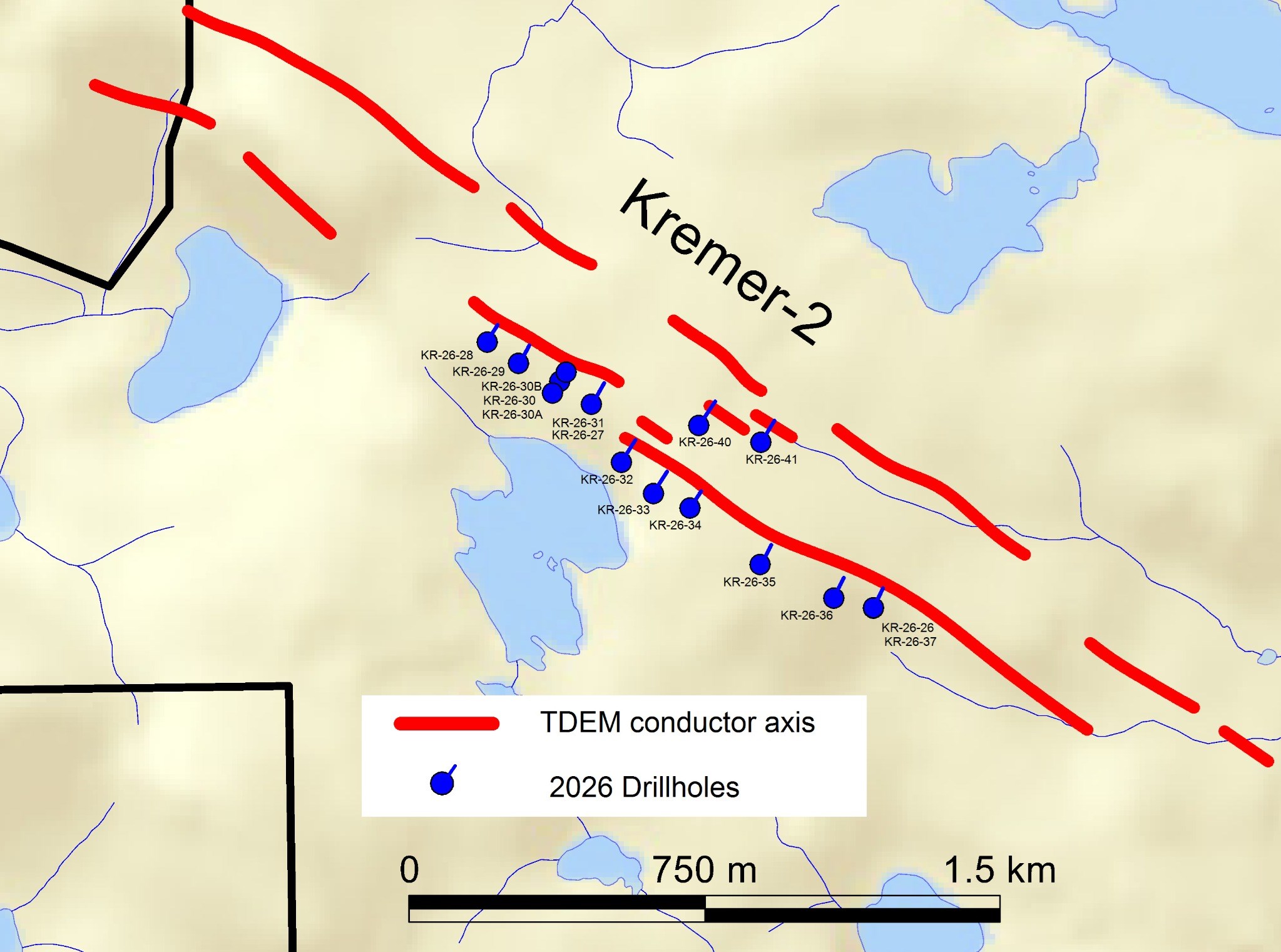
Figure 2. Kremer-2 map showing the interpreted TDEM conductor axes and 2026 drill holes.
To view an enhanced version of this graphic, please visit:
https://images.newsfilecorp.com/files/12654/324946_42a7650864d97af0_003full.jpg
Phase-one objectives achieved; preparing for spring 2027
Having achieved the principal geological objectives of the first drilling phase, Ni-Co has paused additional drilling to integrate the remaining 2026 assays, detailed core logging, interpretation of the 11 completed borehole electromagnetic (BHEM) surveys and ongoing University of Ottawa research. This work will help clarify the relationships between the shallow sulphide lenses, deeper mafic and ultramafic rocks and interpreted electromagnetic conductors, refine the Company's geological model and prioritize the most prospective targets for the second phase of drilling, anticipated to resume in spring 2027.
Management commentary
Alain Tremblay, President and Chief Executive Officer of Ni-Co, commented:
"The first phase of our drilling has delivered the geological evidence we set out to obtain. We confirmed nickel-copper-cobalt mineralization in the shallow part of Kremer-2 and intersected mafic and ultramafic rocks at depth, including units associated with visible sulphides. Together, these results advance our understanding of Kremer and give us a stronger geological basis for planning the next phase of exploration."
"When we launched this program on September 8, we stated: 'We will advance the project step by step, based on drilling data, assays and borehole electromagnetic surveys.' We are following through on that commitment. Having achieved our initial geological objectives, we are pausing drilling to fully evaluate the evidence gathered in the first phase before selecting the next holes. Our team will integrate the remaining assays as they become available, interpret the 11 completed BHEM surveys and incorporate the findings of our University of Ottawa research partners. Together, this work will help prioritize the most prospective targets for the second phase of drilling, which we currently anticipate resuming in spring 2027. Additional shallow and deeper opportunities remain at Kremer-2, while follow-up at Kremer-1 and initial drilling at Kremer-3 are still ahead."
Marc Boivin, P.Geo., Vice President, Exploration, and the Company's Qualified Person, added:
"Our interpretation of Kremer is evolving from a model focused on structurally remobilized sulphide lenses toward a model that also considers primary magmatic sulphide accumulations associated with mafic and ultramafic intrusive rocks. Drilling has intersected several of these lithologies at depth, including locally sulphide-bearing noritic and gabbro-noritic units. Our next priorities are to refine their geological relationships and geometry, interpret the completed BHEM surveys for potential off-hole targets, and determine where nickel-copper-cobalt-bearing sulphides may occur over meaningful widths."
Technical information, sample preparation and QA/QC
Core samples were submitted to AGAT Laboratories for analysis. The reported base-metal and sulphur analyses used sodium-peroxide fusion followed by ICP-OES, with over-limit iron determinations where required; precious metals were analyzed by fire assay with an ICP-OES finish.
The length-weighted results in Table 1 exclude a repeat analysis of the same core footage. No mineral resource, mineral reserve or metallurgical recovery has been established at Kremer.
Qualified Person
The scientific and technical information in this release has been reviewed and approved by Marc Boivin, P.Geo., Vice President, Exploration of Ni-Co, a Qualified Person under National Instrument 43-101. Mr. Boivin is not independent of the Company.
About Ni-Co Energy Inc.
Ni-Co is a Québec-focused mineral exploration company advancing its 100%-owned Kremer nickel-copper-cobalt project, located within ZEC Lavigne approximately 90 km north of downtown Montréal. The Company's objective is to explore for nickel, copper and cobalt mineralization in Québec, with a focus on critical minerals required for electrification, energy-transition technologies and industrial supply chains.
For further information
Nicolas Tremblay | Vice President, Investor Relations & Corporate Development
Ni-Co Energy Inc. | 819-485-1602 | info@nicoenergy.ca | www.nicoenergy.ca
Cautionary statement regarding forward-looking information
This release contains forward-looking information under applicable securities laws, including statements concerning the interpretation of pending laboratory results and completed BHEM surveys; ongoing research with the University of Ottawa; the evolving geological model; additional exploration targets at Kremer-1, Kremer-2 and Kremer-3; the selection of future drill locations; and the anticipated resumption of drilling in spring 2027. These statements reflect management's current assumptions concerning geological interpretation, laboratory and research results, technical services, site access, permitting, contractor availability, operating conditions and funding. Actual results may differ materially due to, among other factors, geological uncertainty, variable grades, discontinuous mineralization, metallurgical limitations, interpretation risk, permitting and community matters, market conditions and other operational or financing risks. The Company undertakes no obligation to update forward-looking information except as required by law.
Neither the TSX Venture Exchange nor its Regulation Services Provider (as that term is defined in the policies of the TSX Venture Exchange) accepts responsibility for the adequacy or accuracy of this release.
Investing News Campaign Agreement
Ni-Co has retained Dig Media Inc., doing business as Investing News Network ("INN"), pursuant to an investing news campaign agreement that commenced on April 13, 2026. INN is a private company headquartered in Vancouver, British Columbia, dedicated to providing independent news and educational content to investors. INN is an arm's-length party to the Company.
Under the 12-month agreement, INN provides advertising and investor awareness services to increase Ni-Co's visibility within the investment community. These services include maintaining and updating the Company's profile on investingnews.com, coverage through INN newsletters, investor-focused promotional and digital advertising activities, and facilitating connections between the Company and investors.
The total consideration payable to INN under the agreement is C$30,000, payable in quarterly instalments. INN does not provide market-making services and currently holds no securities of Ni-Co Energy Inc.

To view the source version of this press release, please visit https://www.newsfilecorp.com/release/324946
News Provided by TMX Newsfile via QuoteMedia