The Conversation (0)

Great Pacific Gold Corp. (TSXV: GPAC,OTC:GPGCF) (OTCQX: GPGCF) (FSE: 0B3) ("Great Pacific Gold", "GPAC", or the "Company") is providing additional technical detail on encouraging results from ongoing geological mapping, trenching, surface sampling and MobileMT-supported targeting completed across the Elamaraka and Kargalio vein systems (the "EK Target Area") at its flagship Wild Dog Project ("Wild Dog" or the "Project"), located on the island of New Britain, Papua New Guinea ("PNG").
The Company has three working groups at Wild Dog: 1) a diamond drilling and geology team with two rigs focused on expanding resources in the Main Zone of the >15km long epithermal vein corridor; 2) a drill pad and road construction crew building drill pads ahead of drilling, and 3) a field exploration geology team – advancing targets in preparation for future drilling campaigns. An update on drilling was recently provided on May 20, 2026, and this release elaborates on field work in the EK Target Area.
Highlights – Elamaraka
Highlights – Kargalio
"Recent exploration work continues to expand the interpreted footprint of epithermal Au-Cu mineralization south of the existing Sinivit-Kavasuki area and further supports the Company's evolving interpretation of Wild Dog as a large-scale magmatic-hydrothermal system containing multiple structurally controlled mineralized centres distributed across a broader district-scale corridor," stated Callum Spink, VP Exploration.
"Importantly, the southern portion of the main Wild Dog corridor is rapidly emerging as a growing pipeline of high-priority exploration targets where geological mapping, geochemistry, structural interpretation and MobileMT geophysics are increasingly converging on coherent mineralized trends extending beyond the currently drilled portions of the district."
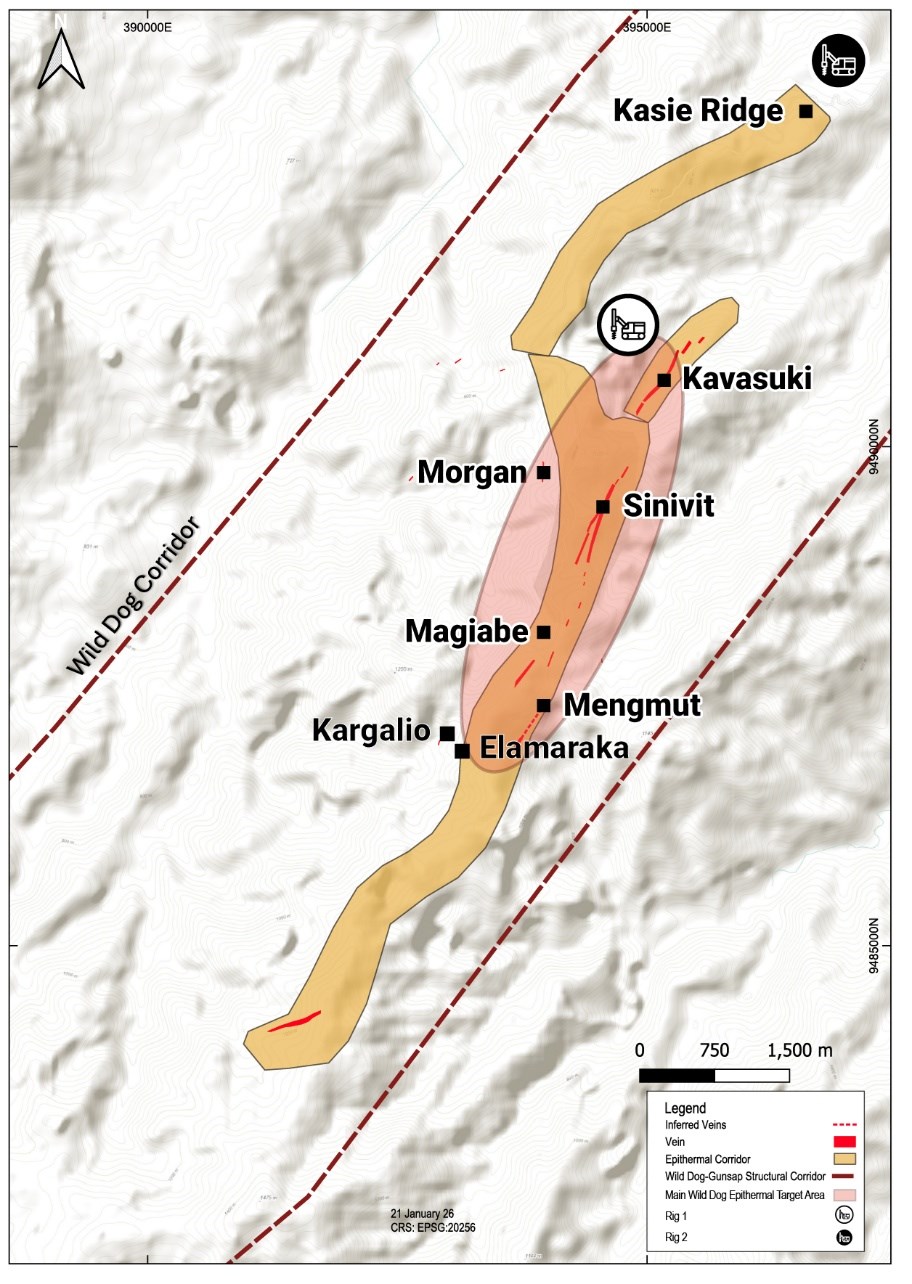
Figure 1: Simplified plan view of the Wild Dog Structural Corridor highlighting key Main Zone epithermal target areas, current drilling locations, interpreted structural trends and priority exploration targets.
To view an enhanced version of this graphic, please visit:
https://images.newsfilecorp.com/files/11018/298992_0b8898e464a2ab11_002full.jpg
Elamaraka Vein System – Mapping and Sampling
The Elamaraka prospect is located approximately 2 km southwest of the Sinivit Deposit and is interpreted to form part of the Sinivit-Kavasuki epithermal corridor within the broader Wild Dog structural system.
Historical trenching completed by previous operators returned results of up to 6 m @ 4.04 g/t Au1 and established Elamaraka as a priority follow-up target within the southern corridor. Recent exploration work completed by GPAC has significantly improved the geological understanding of the Elamaraka system and materially expanded the interpreted footprint of hydrothermal alteration and sulphide-bearing quartz vein development beyond the historically mapped vein exposure.
Geological mapping (Figure 2) identified multiple structurally controlled quartz-sulphide vein arrays developed within fault-shear corridors and associated with widespread silica-sericite-pyrite alteration. Mineralization is characterised by sheeted quartz-pyrite ± chalcopyrite veins, fracture-controlled sulphide development and localised crackle-style quartz-silica brecciation consistent with the broader Wild Dog epithermal environment.
Surface bench sampling returned 2.21 g/t Au, 10.2 g/t Ag and 0.04% Cu (Figure 3) across a 6 m exposed sulphide-bearing quartz vein zone. Additional anomalous Au-Cu values were returned from adjacent vein splays and parallel structures, further supporting the interpretation of a laterally extensive mineralized hydrothermal system within the southern corridor.
The recognition of multiple mineralized structures, broad hydrothermal alteration zones and associated geochemical anomalism suggests the Elamaraka system is considerably more extensive and structurally complex than previously recognised.
Ongoing exploration work will focus on additional trenching, detailed structural mapping and surface sampling designed to refine the continuity, orientation and controls on mineralization and prioritise future drill targets across the broader Elamaraka target area.
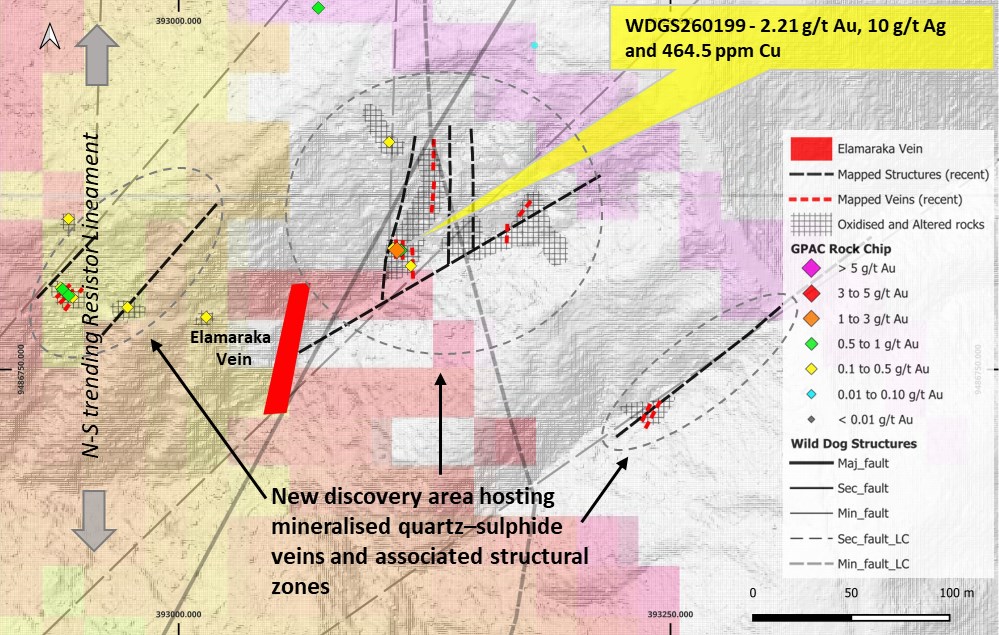
Figure 2: Plan map of the Elamaraka Vein system showing geological mapping, interpreted structures, quartz-sulphide vein trends and surface geochemical sampling results.
To view an enhanced version of this graphic, please visit:
https://images.newsfilecorp.com/files/11018/298992_0b8898e464a2ab11_003full.jpg
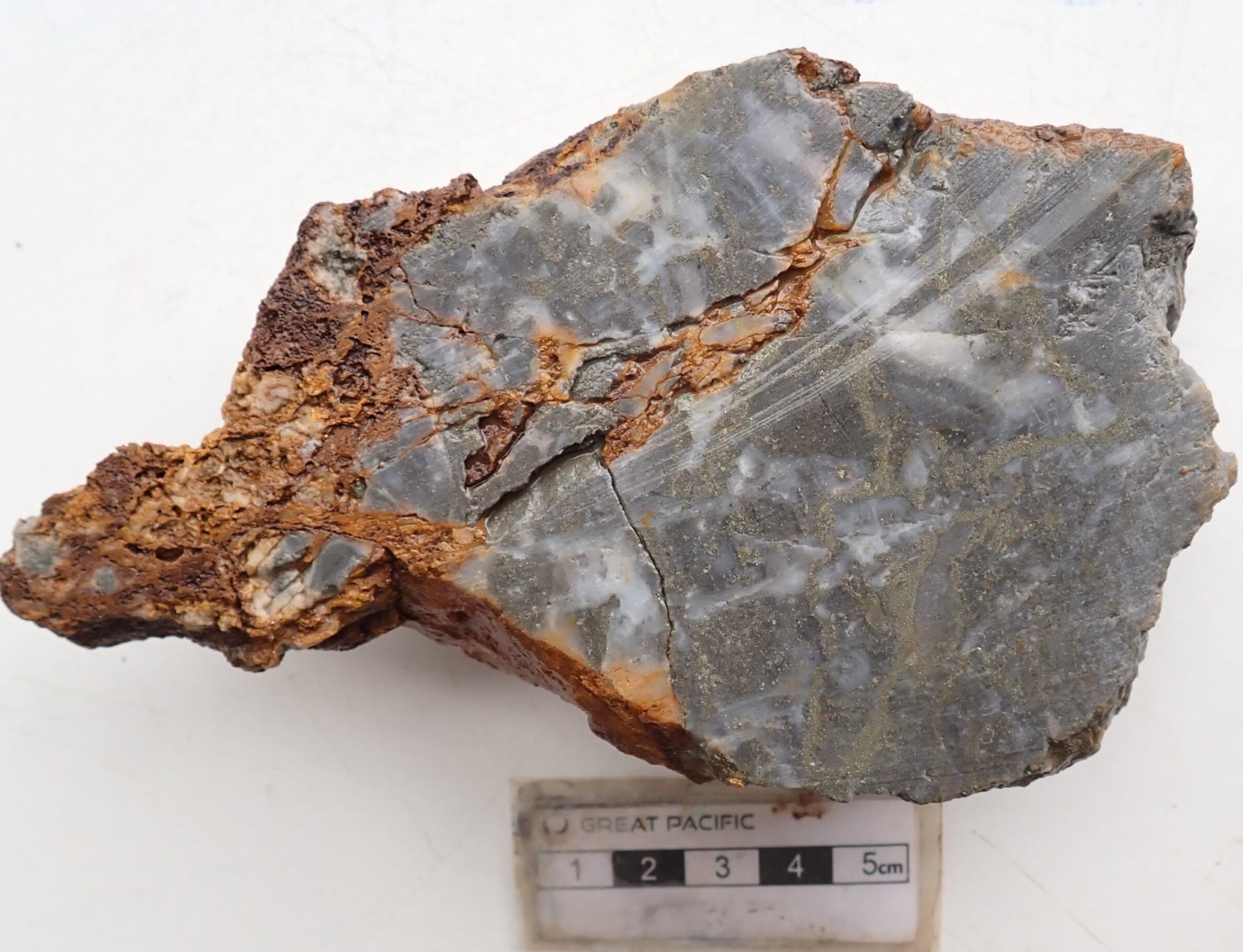
Figure 3: Surface sample WDGS260199 from the Elamaraka Vein system showing grey quartz-silica-pyrite vein material with sericite-illite-pyrite alteration, fracture-controlled oxidation and disseminated fine-grained pyrite ± arsenopyrite sulphide mineralization (2.21 g/t Au, 10.2 g/t Ag and 465 ppm Cu).
To view an enhanced version of this graphic, please visit:
https://images.newsfilecorp.com/files/11018/298992_0b8898e464a2ab11_004full.jpg
Kargalio Vein System –- Mapping and Sampling
Kargalio represents one of the highest-grade historical vein targets identified within the southern Wild Dog corridor, with historical trenching completed by previous operators returning up to 6 m @ 11.9 g/t Au1.
Recent geological mapping (Figure 4) undertaken by GPAC has identified a steeply dipping N-S trending fault-shear corridor approximately 16 m wide hosting quartz-pyrite vein material, pervasive silica, hydrothermal brecciation and sulphide mineralization associated with strong silica-sericite alteration (Figure 5). Additional subordinate quartz-sulphide vein splays were also identified adjacent to the main structural corridor.
Importantly, Kargalio is spatially associated with a strong N-S trending MobileMT resistivity anomaly extending approximately 780 m along strike and to an interpreted depth of approximately 450 m below surface. The vertically continuous resistive feature is considered consistent with extensive silicification and structurally focused quartz vein development within the southern Wild Dog hydrothermal corridor.
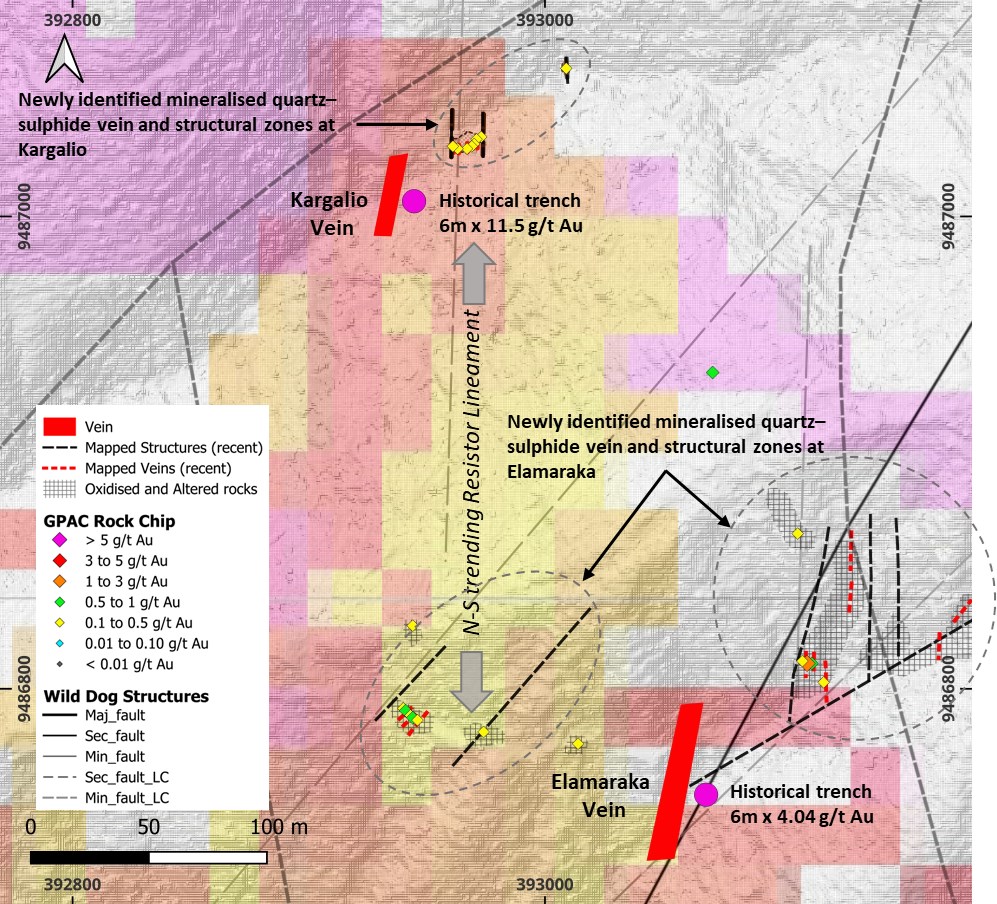
Figure 4: Plan view of the Kargalio and Elamaraka target areas showing surface geochemical sampling, interpreted structures, quartz-sulphide vein trends and MobileMT geophysical context.
To view an enhanced version of this graphic, please visit:
https://images.newsfilecorp.com/files/11018/298992_0b8898e464a2ab11_005full.jpg
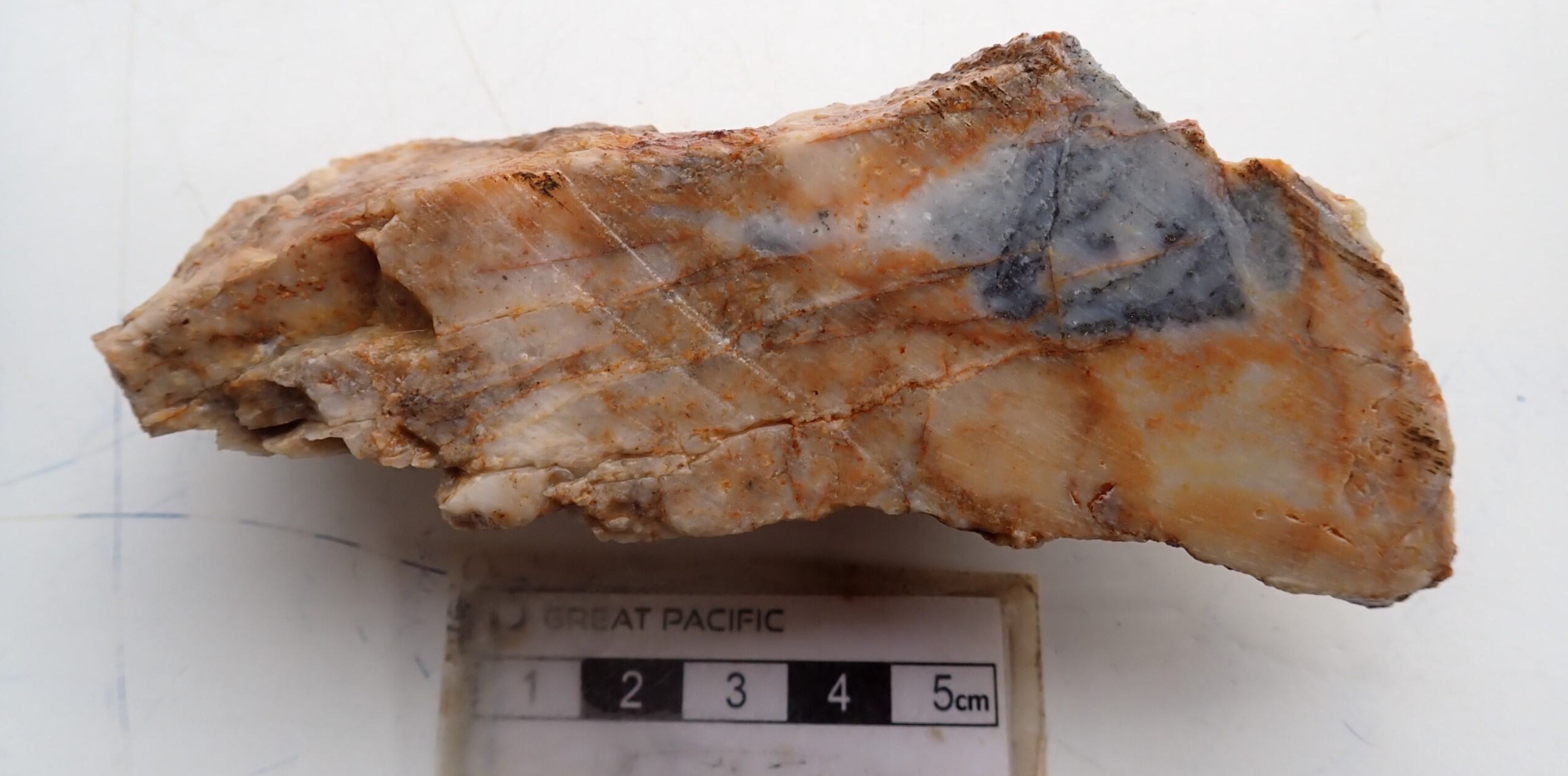
Figure 5: Rock-chip sample WDGS260242 collected northeast of the main Kargalio Vein showing quartz-silica-pyrite vein material associated with silica-sericite-pyrite alteration, late-stage silica overprinting and disseminated fine-grained sulphide mineralization.
To view an enhanced version of this graphic, please visit:
https://images.newsfilecorp.com/files/11018/298992_0b8898e464a2ab11_006full.jpg
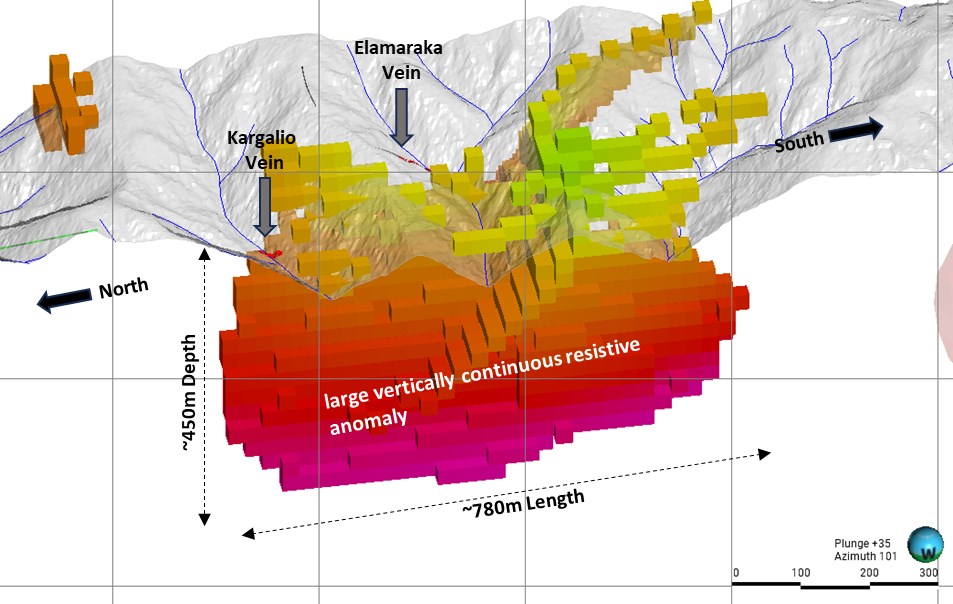
Figure 6: Oblique MobileMT resistivity view highlighting a vertically continuous N-S trending resistive anomaly extending to approximately 450 m depth beneath the Kargalio and Elamaraka vein systems. The resistive feature is spatially associated with mapped quartz-sulphide vein outcrops and interpreted structural corridors.
To view an enhanced version of this graphic, please visit:
https://images.newsfilecorp.com/files/11018/298992_0b8898e464a2ab11_007full.jpg
Elevated copper values associated with chalcopyrite-bearing quartz-sulphide veins support the interpretation of a polymetallic Au-Cu hydrothermal system with geological characteristics consistent with the broader Wild Dog epithermal environment. Surface oxidation developed within portions of the vein system is considered encouraging in the context of exploration targeting and may indicate transition into fresh sulphide mineralization at relatively shallow depth.
Additional geological mapping, trenching and surface sampling programs are planned to further refine the geometry, continuity and scale potential of the Kargalio system and prioritise drill targets associated with the interpreted MobileMT structural corridor.
Expanding Exploration Success Along the Southern Wild Dog Structural Corridor
Elamaraka and Kargalio represent two emerging exploration targets located within the southern extension of the Wild Dog-Sinivit structural corridor approximately 2 km southwest of the existing Sinivit-Kavasuki mineralized system.
Recent exploration programs completed by GPAC continue to demonstrate that mineralization at Wild Dog is not confined to the existing Sinivit-Kavasuki mineralized system, but instead appears to be distributed across a much broader structurally linked hydrothermal corridor extending for several kilometres along strike.
The continued identification of sulphide-bearing quartz vein systems, hydrothermal alteration zones, elevated Au-Cu geochemistry and coincident MobileMT structural features across multiple southern targets is materially improving the Company's understanding of the broader Wild Dog mineral system and strengthening the evolving district-scale exploration model.
GPAC's exploration strategy remains focused on resource drilling on the main Wild Dog epithermal targets in 2026, while systematically advancing a growing pipeline of targets through integrated geological mapping, trenching, geochemistry, MobileMT-supported structural interpretation and drill planning.
Table 1: Summary of selected surface rock-chip, channel and surface bench sample results from the Elamaraka and Kargalio vein systems within the southern Wild Dog structural corridor.
| Sample ID | Sample Type | Target | Easting | Northing | Au (g/t) | Ag (g/t) | Cu (ppm) |
| WDGS260197 | Rock Chip (channel) | Elamaraka | 393221 | 9486973 | 0.47 | 3.30 | 149 |
| WDGS260199 | Rock Chip (channel) | Elamaraka | 393219 | 9486973 | 2.21 | 10.2 | 465 |
| WDGS260234 | Rock Chip (channel) | Elamaraka | 393049 | 9486953 | 0.53 | 1.27 | 62 |
| WDGS260236 | Rock Chip (channel) | Elamaraka | 393052 | 9486950 | 0.61 | 1.15 | 53 |
| WDGS260237 | Rock Chip (channel) | Elamaraka | 393054 | 9486949 | 0.26 | 2.28 | 72 |
| WDGS260242 | Rock Chip (grab) | Kargalio | 393117 | 9487225 | 0.13 | 1.12 | 193 |
Surface rock-chip, grab and surface bench samples are selective in nature and may not represent true underlying mineralization.
Notes
On behalf of Great Pacific Gold:
Greg McCunn
Chief Executive Officer and Director
For further information, visit gpacgold.com or contact:
Investor Relations
Phone +1-778-262-2331
Email: info@gpacgold.com
Qualified Person
The technical content of this news release has been reviewed, verified and approved by Callum Spink, Vice President Exploration of Great Pacific Gold Corp., who is a Member of the Australian Institute of Geoscientists (MAIG) and a Qualified Person as defined by National Instrument 43-101 Standards of Disclosure for Mineral Projects. Mr. Spink has reviewed and verified the geological interpretation, exploration data, sampling procedures, analytical results and geophysical interpretation referenced in this news release and takes responsibility for the technical content contained herein. Mr. Spink is not independent of the Company.
Quality Assurance / Quality Control (QAQC)
The Company follows industry-standard Quality Assurance and Quality Control (QA/QC) procedures for the collection, handling and analysis of exploration samples. Rock-chip and surface bench samples referenced in this release were collected by Great Pacific Gold geological staff and submitted to Intertek Minerals Ltd. in Lae, Papua New Guinea, an ISO 9001-certified independent analytical laboratory with internationally recognised quality standards.
Samples were dried, crushed and pulverised prior to analysis. Gold analyses were completed by fire assay, while silver and copper analyses were completed using multi-element methods following four-acid digestion (MS48) and ICP-OES/MS analysis.
Certified reference materials (standards), blanks and field duplicates were inserted into the sample stream at industry-standard frequencies, including routine insertion of blanks following mineralized intervals. All assay batches received to date have passed QA/QC review and fall within acceptable tolerance limits.
Sampling procedures and chain-of-custody protocols were managed by Company geologists and field staff in accordance with industry best practices. Rock-chip and surface bench samples are selective in nature and may not be representative of the underlying mineralized system.
About Great Pacific Gold
Great Pacific Gold's vision is to become the leading gold-copper development company in Papua New Guinea ("PNG"). The Company has a portfolio of exploration-stage projects in PNG, as follows:
The Company also holds the Tinga Valley Project in PNG.
Forward-Looking Statements
Information set forth in this news release contains forward-looking statements that are based on assumptions as of the date of this news release. These statements reflect management's current estimates, beliefs, intentions and expectations. They are not guarantees of future performance. Great Pacific Gold cautions that all forward-looking statements are inherently uncertain and that actual performance may be affected by many material factors, most of which are beyond their respective control. Such factors include, among other things: risks and uncertainties relating to Great Pacific Gold's limited operating history, its exploration and development activities on its mineral properties and the need to comply with environmental and governmental regulations. Accordingly, actual and future events, conditions and results may differ materially from the estimates, beliefs, intentions and expectations expressed or implied in the forward-looking information. Except as required under applicable securities legislation, Great Pacific Gold does not undertake to publicly update or revise forward-looking information.
Mineralization at the properties held by K92 Mining Inc. and at the Wafi-Golpu deposit is not necessarily indicative of mineralization at the Wild Dog Project.
Neither TSX Venture Exchange nor its Regulation Services Provider (as that term is defined in the policies of the TSX Venture Exchange) accepts responsibility for the adequacy or accuracy of this release.
To view the source version of this press release, please visit https://www.newsfilecorp.com/release/298992
News Provided by TMX Newsfile via QuoteMedia