The Conversation (0)
How carbon-aware software engineering and hardware optimization are reshaping how Mastercard builds, runs and measures its technology stack.
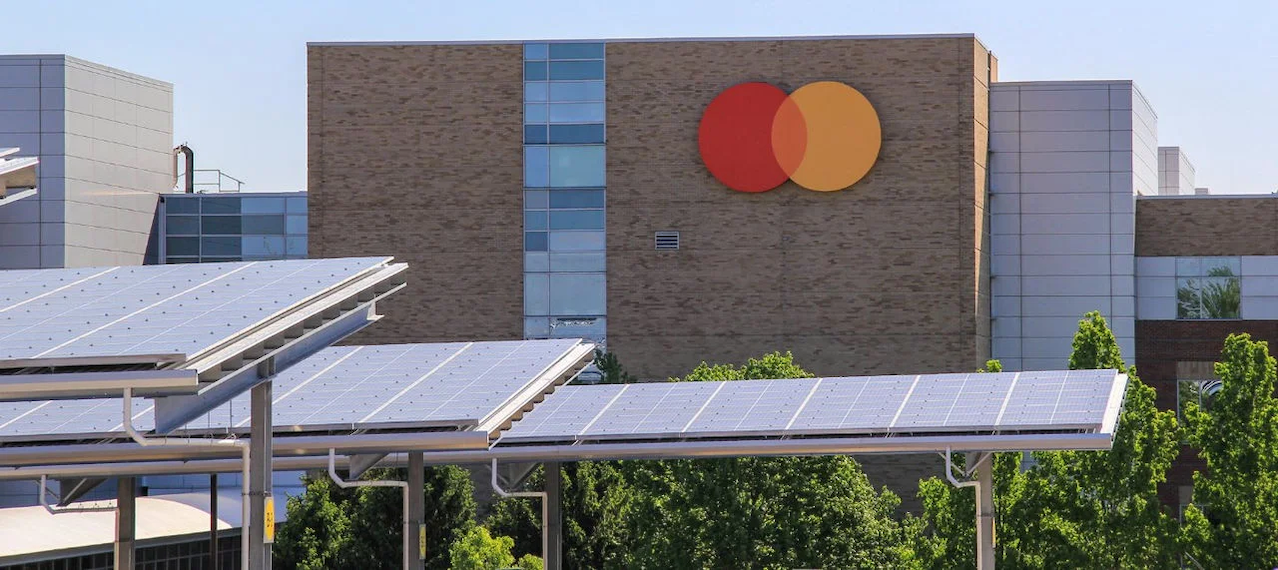
NORTHAMPTON, MA / ACCESS Newswire / April 23, 2026 / Renewable energy at Mastercard's facilities, such as solar panels at the St. Louis Tech Hub, advance the company's environmental goals and increase resilience, including for neighbors and the local grid. (Photo credit: Christopher Polley)
By: Ellen Jackowski
Chief Sustainability Officer, Mastercard
Adam Tenzer
Senior Vice President, Data and Governance, Technology, Mastercard
The power of today's technologies has made payments faster, more seamless and more secure. Greater data availability means richer insights. AI is making more things possible. It's an exciting future for all of us at Mastercard as we power commerce around the globe. But as we grow, can we do so sustainably? Our company has spent 10 years testing that hypothesis and has found that the answer can be yes.
In 2025, we achieved and exceeded our interim emissions targets, reducing absolute Scope 1 and 2 location-based emissions by 44% (target was 38%) and Scope 3 by 46% (target was 20%) from 2016 levels. Even while growing net revenue by 16%, our emissions decreased by 1% year over year. This marks our third consecutive year decreasing emissions, showing signs that decoupling emissions from growth is possible.
These results reflect a comprehensive approach built on renewable energy investment and procurement, supply chain engagement and embedding environmental sustainability into everyday business decisions. We also recognize the magnitude of what lies ahead. Powering payments for the digital economy requires a global technology stack, and our emissions are directly shaped by the efficiency of the applications we build, the hardware they run on and the data centers and energy behind that hardware. Understanding each layer is essential to driving progress.
Today, our data centers make up the largest share of our energy use, accounting for roughly 60% of our Scope 1 and Scope 2 greenhouse gas emissions, defined as our direct emissions (Scope 1) and indirect emissions from purchasing energy and cooling (Scope 2). Technology goods and services also drive one-third of our Scope 3 emissions. Scope 3 emissions primarily reflect indirect impacts across our supply chain.
A key lever in decreasing emissions remains renewable energy. But our technology team has also taken on the challenge to innovate further. As we execute our technology strategy, the design and use of modern, sustainable platforms have become central to our overall objectives. Our Sustainable Technology Steering Committee formalizes the work, provides accountability and drives action. And a specific sustainable technology initiative has been one of four key technology imperatives that our teams have prioritized the past two years.
Driving action with data
Since 2023, we've focused on developing ways to capture and bring together more and more granular data reflecting our own business practices to provide greater visibility into the performance and impact of technology. The result has been a comprehensive dashboard - now patent-pending - that provides a single Sustainability Score for each product and technology asset. That score is comprised of a number of metrics that provide unique insights to drive real action across our technology stack, including:
Real-time energy consumption (kWh) of hardware, tech-related carbon intensity by region and location-based emissions
Server utilization and hardware life-cycle indicators
Amount of convergence of technical assets, like software applications and databases, onto a single physical system like a server
Today, this data is driving comprehensive action across our technology stack, helping us manage our emissions even as we grow. Here are a few examples.
Engineering sustainable applications
Running environmentally sustainable technology starts with how we engineer the applications that power our products. The Sustainability Special Interest Group (SSIG) - part of our Software Engineering Guild, which unites thousands of our engineers across geographies and products - has helped lead the way. The SSIG has integrated principles from the nonprofit Green Software Foundation into the way we build, while helping develop Mastercard's own architectural patterns and engineering practices to ensure more efficient application design, runtime optimization and carbon-aware decision making.
Energy-use data on individual technologies from our dashboard, as well as case studies on the impact of these practices, have helped shape practices across our software engineering community. And these practices have become more than recommendations. They've become codified within Mastercard's engineering principles. These practices are also part of internal architecture and engineering review board processes, ensuring new applications are evaluated for efficiency and carbon impact before they're deployed into production.
Optimizing hardware
Once applications are built, they need infrastructure to run on - hardware devices like servers, network switches and storage. Optimizing that infrastructure to efficiently utilize our compute and storage capacity while managing emissions is another component of our sustainable technology strategy.
One physical server running at an optimally higher CPU utilization consumes energy more efficiently than two physical servers running at low utilization. With visibility into which applications are using how much of each hardware device across each location, we've identified underutilized hardware, then consolidated and decommissioned devices when possible. The impact? Over 3,700 hardware devices removed since 2024. And we're accelerating, already decommissioning hardware devices at nearly double the rate in the first quarter of 2026 compared with the same period last year.
But it's not only on or off. Dynamic power settings enable us to adjust power used by devices in real time, based on the processing required or the workloads being managed. When we're not decommissioning unneeded hardware, we're scaling the use of dynamic power settings to help mitigate the energy consumption of physical servers. Pulling together emissions metrics for both devices and applications helps us identify new opportunities, allowing us to scale the use of server CPUs' dynamic power settings.
Where we run our technology
Mastercard's technology ecosystem includes owned, co-located and cloud environments. That's where the hardware powering the applications we build runs. Our suppliers, including co-located and cloud environments, contribute to our overall emissions, so we've coordinated closely with suppliers to help advance our sustainability goals.
Through collective efforts with co-located data center operators, we've brought greater visibility to our operations, with actual energy and emissions data collected directly from providers. We've also worked to close gaps in cloud emissions tracking, adopting new methodologies and partnering with data analytics provider Greenpixie to obtain more comprehensive carbon and energy metrics and to standardize reporting across vendors.
Accurate measurement of application workloads across co-located and cloud environments is enabling more informed decisions. With this data, we're able to right-size and right-place workloads across environments while further optimizing where we operate our infrastructure, based on carbon intensity and available energy sources.
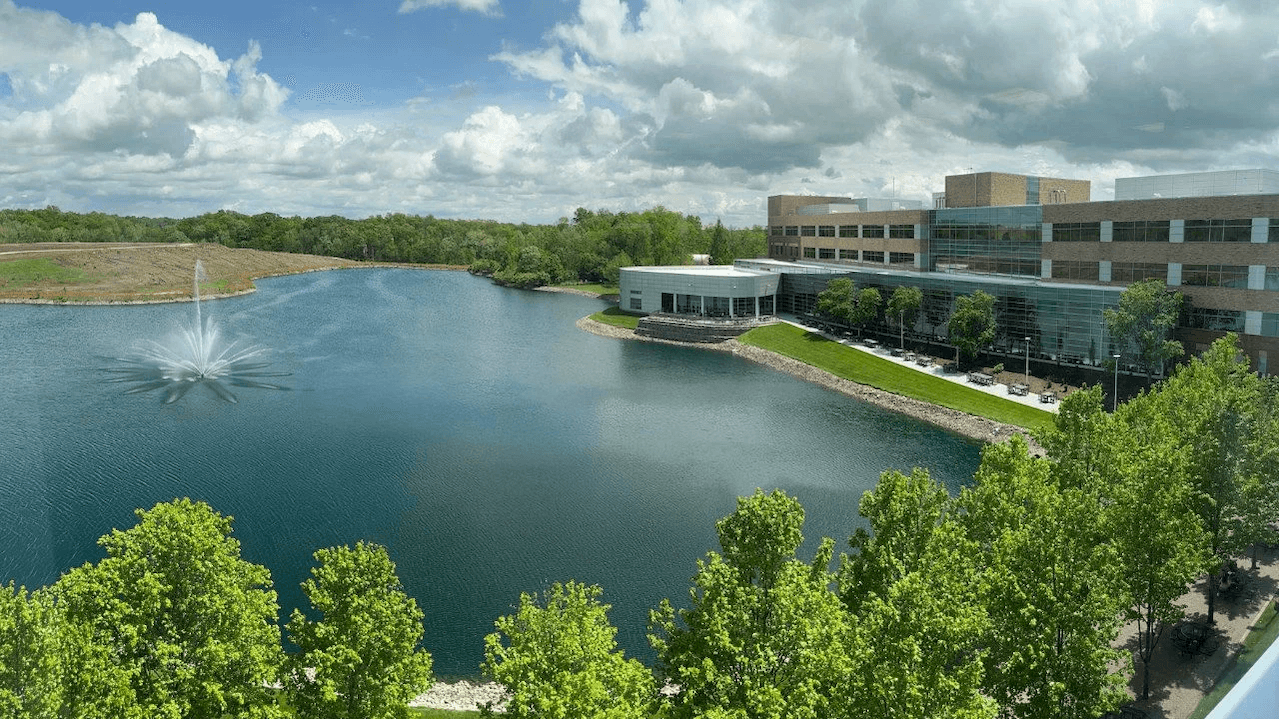
The lake outside Mastercard's St. Louis Tech Hub serves as a back-up source of water for the company's chillers, which cool the company's data center. (Photo credit: Mira Belgrave)
Delivering business results and environmentally sustainable outcomes
Our 2025 results - achieving our interim emissions-reduction targets and reporting three consecutive years of decreasing emissions with profitable growth - reflect a conviction that we believe the technology sector must embrace: environmental sustainability does not have to be a constraint on performance; it can be a catalyst for it. The discipline required to manage environmental impact reveals inefficiencies, reduces waste and builds resilience. When you treat environmental impact as a core business objective rather than a side initiative, it strengthens the entire enterprise.
This work is inseparable from Mastercard's broader mission. The same infrastructure and practices that enable us to make progress toward decoupling emissions from growth also power the tools we offer customers - connecting people to the digital economy, helping consumers and businesses make more sustainable choices and enabling circular economy models.
Continue reading here
Find more stories and multimedia from Mastercard at 3blmedia.com.
Contact Info:
Spokesperson: Mastercard
Website: https://www.3blmedia.com/profiles/mastercard
Email: info@3blmedia.com
SOURCE: Mastercard
View the original press release on ACCESS Newswire