The Conversation (0)

New Age Exploration (ASX: NAE) (NAE or the Company) is pleased to announce the commencement of drilling at its Lammerlaw Project in New Zealand. The drill program is Phase 1 of a two-phase program to test nine high-priority targets identified through extensive geochemical surveys, geological mapping, and geophysical data interpretation.
HIGHLIGHTS
The phase 1 drilling programme at Lammerlaw, Permit 60807 (Figure 1), is focused on confirming the style of mineralisation that gives rise to gold, antimony, and tungsten anomalies identified in soil sampling and at historical workings. The Lammerlaw Project hosts several west-northwest mineralised zones sub-parallel to foliation in schist and airborne geophysical trends. The mineralised zones are defined by NAE soil samples, a compilation of previous exploration data, survey of historic workings and are approximately 4 km long.
The Lammerlaw permit is primarily covered by a layer of loess (windblown silt), typically 1-5m deep, that sits on a thin zone of weathered schist and conceals mineralization. Hand augers are used for soil sampling to penetrate the loess. This means that most soil anomalies are buried and cannot be found by surface sampling, and the thin zone of weathered schist means that supergene mineralisation is not well developed.
NAE Executive Director Joshua Wellisch commented:
"We are excited to commence drilling at the Lammerlaw Project, where historical mining and modern exploration have highlighted the strong potential for high-grade gold and antimony mineralisation. This drill program is a key step in advancing the project and unlocking value for our shareholders."
The Phase 1 drilling programme will test 5 of the 9 identified targets, compiled from historic data and NAE soil sampling and which include high-grade discoveries of Au and Sb, along with data from historical production reported previously.
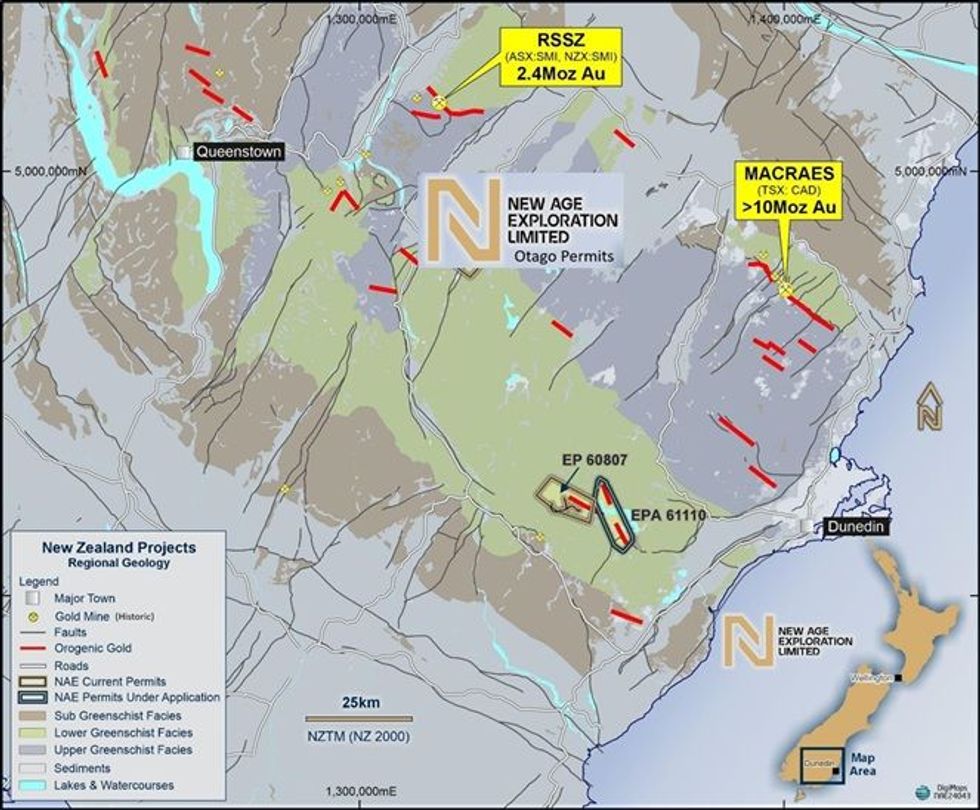 Figure 1: The NAE Lammerlaw permit occurs in the southern limb of a regional fold feature characterised by a change in metamorphic grade from upper greenschist (purple) to lower greenschist (green). At Macraes, mineralisation occurs inshear zone features truncated by structures controlling the change in metamorphic grade.
Each of the selected drill holes will test two types of conceptual targets which could relate to Au, As, Sb or W mineralisation (Figure 2):
1. Mineralisation can occur in shear zones parallel to schist foliation similar to Macreas or Rise n Shine mineralisation. This mineralisation style can be relatively subtle and will likely be detected in pXRF and assay results after drilling is completed
2. Mineralisation can occur in brittle vein structures oriented vertically or at a high angle to schist foliation. This mineralisation style can be detected through mineral analysis during on-site drill hole logging.
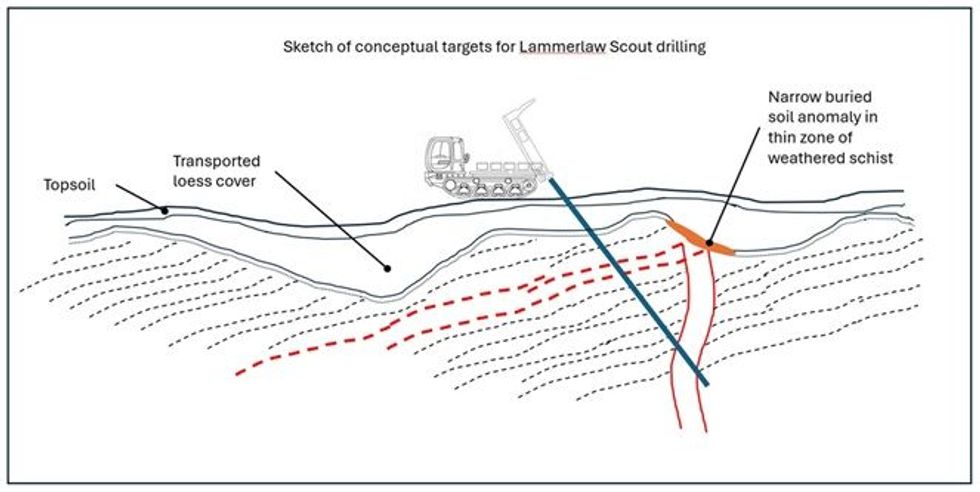 Figure 2: Conceptual targets for Lammerlaw drilling (not to scale). Red dotted lines indicate mineralisation parallel to foliation in schist. Red solid lines indicate vertical or high-angle vein mineralisation. Both could produce a similar buriedsoil anomaly (orange layer).
Soil anomalies derived from either mineralisation style (shear zone or high-angle vein) deliver the same or similar results. Historical mining records indicate that at least some of the mineralisation within the Lammerlaw permit is hosted in brittle vein structures. NAE is the first company to test the concept of shear zone mineralisation parallel to the schist in the Lammerlaw area.
The targets (Figure 3) include zones where several types of mineralisation indicators are aligned. Typically, the mineralisation indicators include historical workings, soil samples with elevated Au values, often coincident elevated As and Sb values and occasionally elevated W values. Once the targets are selected, drill hole locations are sited to intersect both target types within approximately 100m of drilling.
Click here for the full ASX Release
This article includes content from New Age Exploration Limited, licensed for the purpose of publishing on Investing News Australia. This article does not constitute financial product advice. It is your responsibility to perform proper due diligence before acting upon any information provided here. Please refer to our full disclaimer here.