The Conversation (0)
NORTHAMPTON, MA / ACCESS Newswire / November 19, 2026 / Cisco
When disaster strikes, survival often comes down to getting the right answers to simple, but potentially lifesaving, questions: Where can I find a safe place to sleep tonight? How can I get medical attention? Where will my next meal come from?

For humanitarian organizations, AI has the potential to help answer these questions at an exponential scale. It can help get information directly and quickly into the hands of those seeking services they need to recover. But when the people on the other end of the line are at their most vulnerable, the stakes are too high for AI to get the answers wrong.
A shared commitment to responsible AI principles
At Cisco, we believe it is imperative to balance efforts to maximize AI's potential with the responsibility of mitigating risks in how it's built and deployed. We seek to partner with organizations willing to meet the same bar we set for ourselves through our approach to responsible AI, which rests on six core principles.
For more than a decade, the International Rescue Committee (IRC) has been one of those partners. The IRC leads the consortium behind Signpost, a digital information service that has helped 20 million people around the world get timely, verified information about where and how to get assistance during a crisis.
Cisco's support dates back to Signpost's earliest days, when funding from the Cisco Foundation helped launch its precursor in 2015. In the years since, our support has helped the IRC expand the program and build the infrastructure - including offline-accessible service maps and unified data analytics - it runs on today, reaching people across more than 20 countries and in 12 languages.
The newest chapter we're excited to support is SignpostChat, the IRC's effort to build responsible AI directly into the platform - enabling caseworkers to keep pace with an increasing volume of inquiries while expanding the service.
How the IRC connects people to humanitarian assistance with SignpostChat
For people navigating the immediate aftermath of a crisis, not knowing where to turn for help presents its own danger. They often find themselves somewhere unfamiliar, without the networks or local knowledge they'd normally rely on. Finding shelter, food, and safety simply cannot wait.
For years, Signpost caseworkers with lived experience and training personally answered each question that came through the platform, providing credible information to those seeking support. The model works well for the people it reaches, but its impact is limited by the size of the team behind it. "There are only so many questions a caseworker can answer in a day's work," said Briana Orr, Senior Advisor for Responsive Information at the IRC.
Integrating AI into the platform poses clear potential for efficiency and opportunities to scale. But when the people asking the questions are in the middle of a crisis, an automated answer that's incorrect or incomplete can leave them exposed to even more harm in moments of vulnerability. This requires designing a system with guardrails that can help the agent determine not just how to respond, but also when not responding and handing the conversation to a caseworker is the safer, most responsible choice.
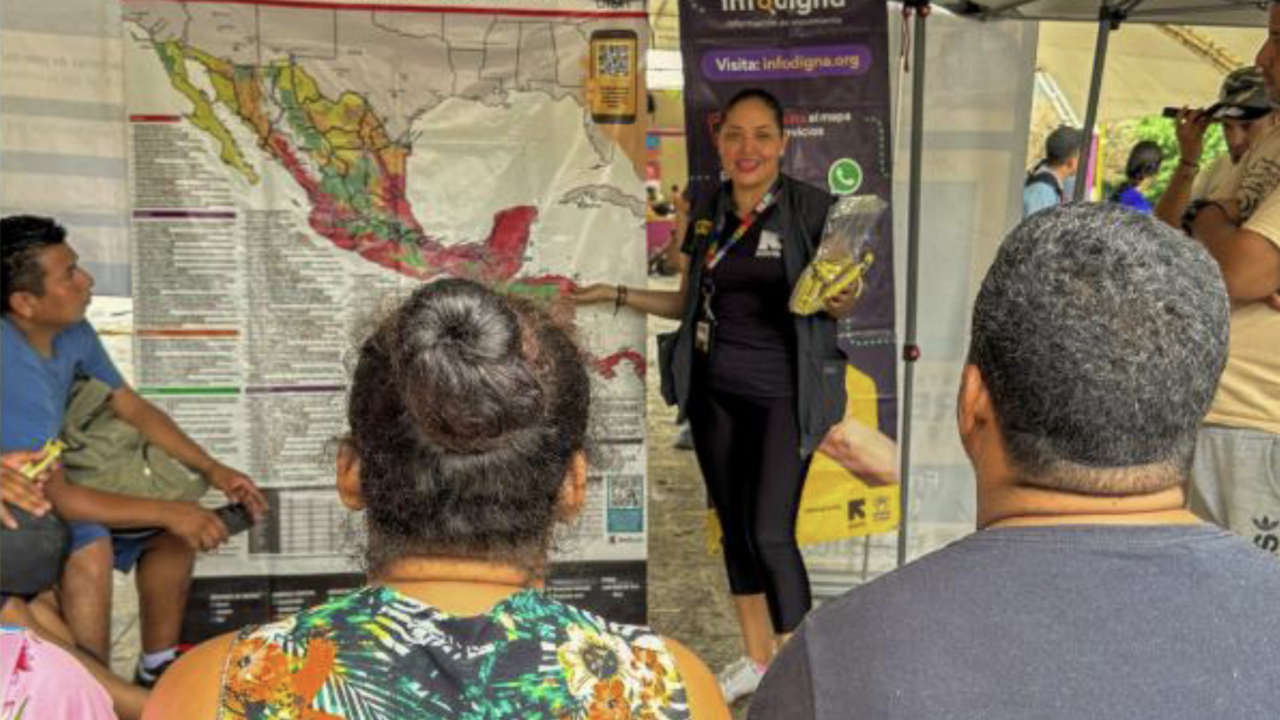
At one of the IRC's mobile units in Mexico, a staff member shares valuable information about available services with people in need of assistance. PC: Everardo Esquivel for the IRC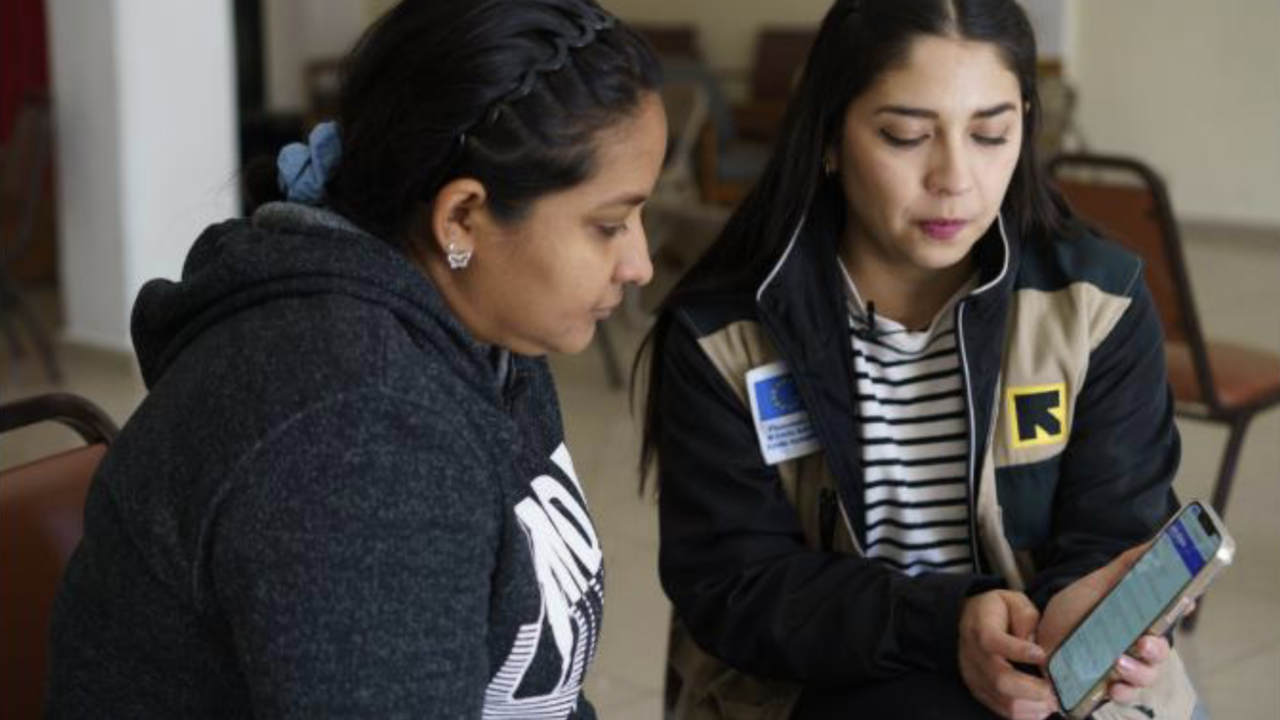
One of the ways the IRC connects people with assistance is through Signpost, known as InfoDigna in Mexico. The digital platform helps people like Maria* access the support they need. PC: Paul Ratje for the IRC

Signpost combines the power of responsible AI with the expertise and lived experiences of human caseworkers to connect people to humanitarian assistance during times of need. PC: Paul Ratje for the IRC
Leveraging AI as a tool - and a teammate
In developing SignpostChat, the IRC made a deliberate decision rooted in the human-in/on-the-loop approach: use AI to extend the reach of its caseworkers, not replace their judgment. The goal was to build a system that could handle more inquiries on its own, while keeping a person in charge of anything too sensitive for an agent to navigate without human supervision.
Getting there took a careful, staged build process. The IRC's team started with simulations, running the system through AI-assisted evaluation and red teaming exercises to establish an initial set of guardrails. Then, they developed and tested a triage methodology until the system behaved reliably within the testing environment.
From there, specialists examined and refined how the AI communicated, down to language choices, training the agents to recognize signs of distress and escalate that conversation to a person rather than attempt to handle it alone.
"We created AI agents that can field questions when it's safe for them to, and hand off to a person when it's not," said Orr. In practice, incoming messages land in one shared queue, where the agent tags the topic being raised while assessing risk. "Sometimes, the agent will provide an initial response but also raise a flag for someone to review later. Other times, like when the case is too sensitive for an agent to engage with, it will flag the inquiry as something that needs human intervention right away."
With SignpostChat, AI agents can provide instant responses in text and voice, including in underrepresented languages, while human moderators focus on the most sensitive cases. The result is a system built to operate within clear boundaries, with agents operating as part of a hybrid human-AI team rather than as a replacement for the specialized caseworkers who lead it.
Early lessons from the SignpostChat Mexico pilot
In July 2026, the IRC began piloting SignpostChat in Mexico, where it operates under the name InfoDigna. Since the AI agent went live, it has supported Signpost's small Mexico-based team to field a steady stream of inquiries from people in need of shelter, food, and other assistance.
"One of the clearest changes has been the speed of initial response," said Luis Alberto Tejeda Carrasco, who led the initial phase of the InfoDigna pilot with the IRC Mexico Signpost team. "Before the pilot, responding to all of the messages could take us hours, sometimes days. Now, people can receive an initial response to most inquiries from the AI agent in under 10 seconds." The tool flags higher vulnerability cases, so the "humans in the loop" can prioritize where they're needed most.
"At every step, our use of AI is grounded in a do-no-harm principle: AI must strengthen - never undermine - the equity, safety, and dignity of the people we serve."
- Luis Alberto Tejeda Carrasco, former senior Signpost officer with the IRC Mexico
The team has already observed instances in which the integration of AI has had immediate positive impacts. "We had one family - a mother, a grandmother, and a child - who had just arrived in Mexico City, afraid for their safety and facing homelessness with no resources to fall back on," recalled Carrasco. "With timely information from the AI agent, they were able to connect with one of Mexico City's largest and safest shelters the very same day." The family later shared feedback through the service, expressing relief and gratitude for no longer having to sleep on the street.
"The goal was to build a hybrid humanitarian support model, linking humans and AI, that could help us respond to more requests while keeping the focus on people's needs and safety," Carrasco said.
What's next for SignpostChat
As the pilot continues in Mexico, the IRC is documenting what they're learning, and these lessons are already informing future deployments of SignpostChat, as well as other AI-enabled initiatives at the IRC. The team is exploring ways to integrate advanced red teaming and model stress-testing earlier in the development cycle to build a system that can scale without compromising the human-centered care that defines the tool. "What we've learned so far can help shape how AI-assisted tools are developed and used responsibly in other humanitarian contexts," said Carrasco.
At Cisco, we believe AI can be harnessed as a genuine force for good in a crisis if the principles underpinning its design are as strong as the technology itself, and we're proud to partner with organizations like the IRC that share that belief. As AI-enabled tools like Signpost scale to reach more people, it's our shared commitment to responsible AI principles that will help us mitigate the risk, maximize the opportunity for impact, and keep people - both the humans in the loop and the ones that we serve - at the center of it all.
View original content here.
Find more stories and multimedia from Cisco Systems Inc. at 3blmedia.com.
Contact Info:
Spokesperson: Cisco Systems Inc.
Website: https://www.3blmedia.com/profiles/cisco-systems-inc
Email: info@3blmedia.com
SOURCE: Cisco Systems Inc.
View the original press release on ACCESS Newswire
