The Conversation (0)

(TheNewswire)
 | |||||||||
 |  |  |  |  | |||||
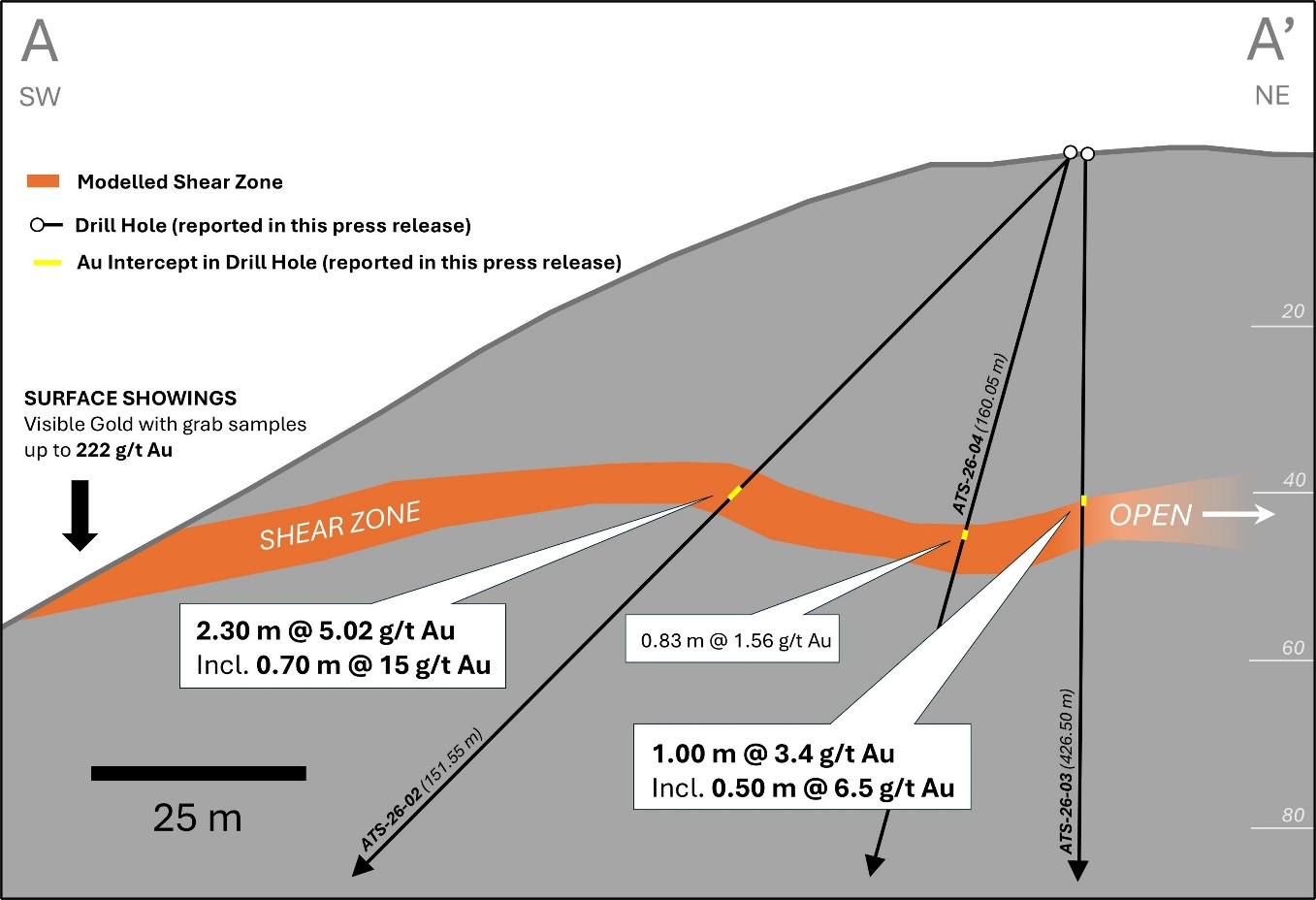
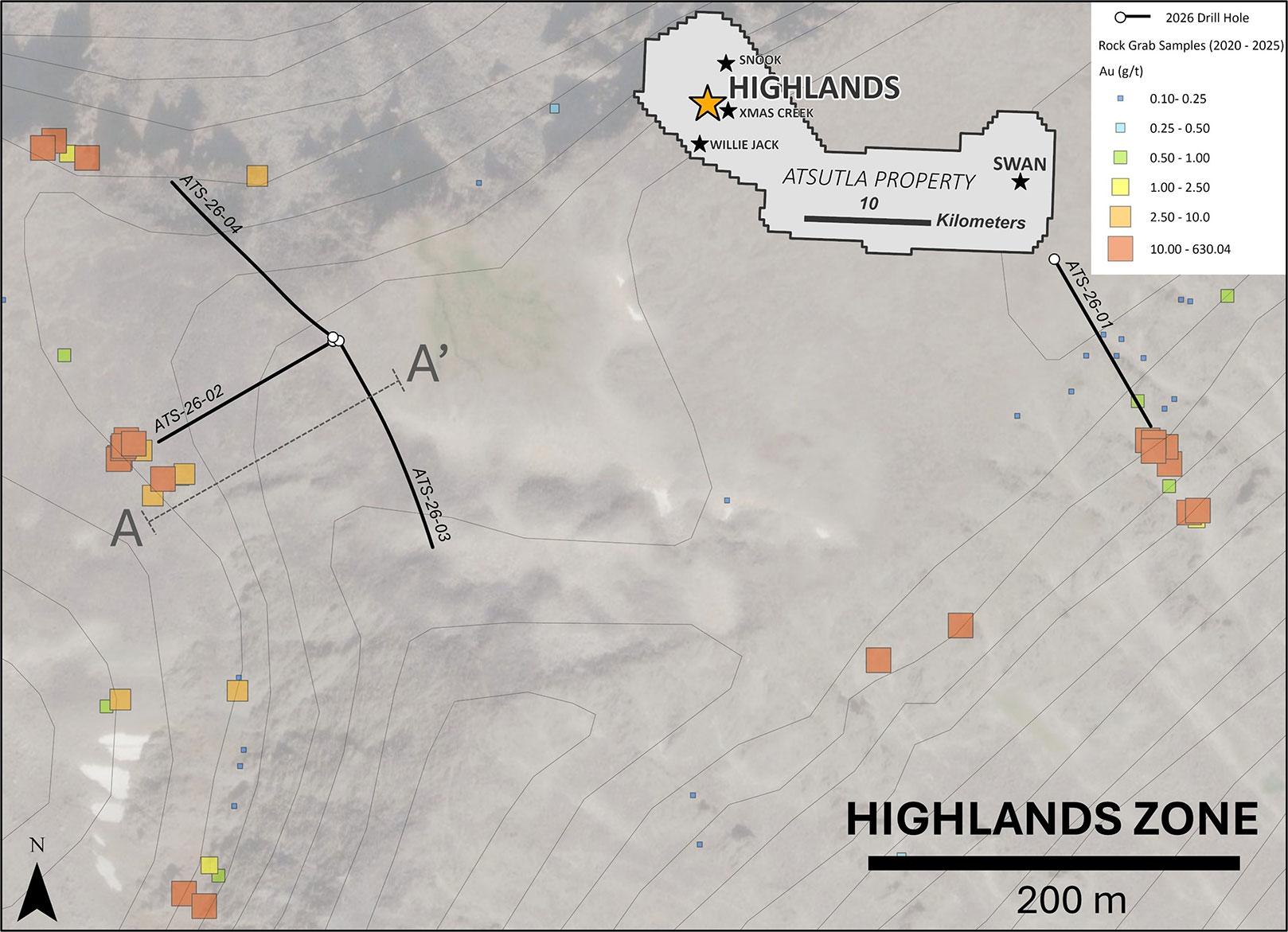
November 9, 2026 TheNewswire - Trailbreaker Resources Ltd. (TBK.V) ("Trailbreaker" or "the Company") is pleased to report assay results from its maiden 2026 Highlands Zone drill program at the Company's 100%-owned, 300 km² Atsutla Gold Project in northwestern British Columbia (BC). Drill hole ATS-26-02 intersected the targeted high-grade gold mineralization at 37.7 m vertical depth, returning 5.02 gt gold (Au) over 2.30 m, including 15.0 gt Au over 0.70 m (Figures 1 and 2).
Daithi Mac Gearait, CEO of Trailbreaker commented, "This is the first drill campaign at Atsutla to target its high-grade gold potential. Multiple high-grade targets remain to be tested. We are eagerly anticipating further pending assays from two drill holes at the Swan Zone, which targeted Cu (copper)-Au-Ag (silver)-Mo (molybdenum) porphyry potential."
Click Image To View Full Size
Figure 1: Drill section for ATS-26-02, ATS-26-03, and ATS-26-04. Figure 2 shows section location on plan map.
Click Image To View Full Size
Figure 2: 2026 drill plan map with section location (A-A') at the Highlands Zone, Atsutla Gold Project.
In early August 2026, Trailbreaker completed a six hole, 1,684-metre drill program at the Project (see August 10, 2026 news release). The program targeted two zones spaced 26 km apart: the Highlands Zone, a high-grade, vein-hosted gold target hosted within the Jurassic Christmas Creek batholith; and the Swan Zone, a Cu-Au-Ag-Mo porphyry target within the Cretaceous Glundebery batholith. The assay results from the Swan Zone remain pending.
The diamond drilling program at the Highlands Zone consisted of four holes totalling 883.40 metres. The Highlands Zone covers a 2.0 km by 1.5 km area in the western Atsutla Gold Project region, and is defined by high-grade gold veins within a shallowly-dipping shear zone, hosted by granodiorite of the Christmas Creek batholith. The drilling tested a strike length of 500 m and a vertical extent of 412 m. Tables 1 and 2 display collar details and assay results, respectively.
All four holes intersected the targeted auriferous shear zone. The shear zone occurs as a 5- to 20-metre-wide zone of moderate to intensely iron-carbonate altered granodiorite. Within these alteration zones, multiple intercepts of fractured rock and fault gouge are present, as well as areas of quartz-carbonate stockwork. Gold grades are associated with quartz veins up to 40 cm wide, commonly with limonitic pyrite, trace galena, and trace arsenopyrite. While mid- to high-grade gold intercepts were encountered, the actual mineralized zone is narrow in the areas tested by drilling.
Table 1: Drill collar details for the 2026 program (*note: assays from the Swan Zone remain pending).
| Zone | Hole | Easting | Northing | Elevation (m) | Azimuth | Dip | Depth (m) |
| Highlands | ATS-26-01 | 345694 | 6580273 | 1803 | 150 | -45 | 145.30 |
| Highlands | ATS-26-02 | 345310 | 6580229 | 1763 | 240 | -45 | 151.55 |
| Highlands | ATS-26-03 | 345313 | 6580229 | 1763 | 150 | -75 | 426.50 |
| Highlands | ATS-26-04 | 345310 | 6580231 | 1763 | 305 | -45 | 160.05 |
| Swan* | ATS-26-05 | 370338 | 6573799 | 1757 | 300 | -55 | 391.35 |
| Swan* | ATS-26-06 | 369371 | 6574191 | 1344 | 120 | -75 | 409.65 |
Table 2: Significant drill intercepts from the Highlands Zone drill program
| Drill Hole | From (m) | To (m) | Length (m) | Au (g/t) | Ag (g/t) |
| ATS-26-01 | 107.00 | 108.00 | 1.00 | 0.10 | 2.0 |
| ATS-26-01 | 109.00 | 110.00 | 1.00 | 0.02 | 105 |
| ATS-26-02 | 28.00 | 29.00 | 1.00 | 0.30 | 0.1 |
| ATS-26-02 | 55.30 | 57.60 | 2.30 | 5.02 | 9.8 |
| ATS-26-02 | including | ||||
| ATS-26-02 | 55.30 | 56.00 | 0.70 | 15.0 | 23.3 |
| ATS-26-03 | 41.50 | 42.50 | 1.00 | 3.42 | 3.2 |
| ATS-26-03 | including | ||||
| ATS-26-03 | 41.50 | 42.00 | 0.50 | 6.50 | 4.7 |
| ATS-26-03 | 334.00 | 334.60 | 0.60 | 0.20 | 6.9 |
| ATS-26-04 | 64.17 | 65.00 | 0.83 | 1.56 | 18.8 |
| ATS-26-04 | 144.34 | 145.00 | 0.66 | 0.12 | 2.4 |
The Highlands Zone Drill Target
Although there are multiple showings of high-grade surficial gold in the Atsutla West area, drilling was conducted solely at the Highlands Zone, where the highest assay grades and greatest density of gold-bearing quartz veins have been mapped within the property boundary to date. Surface sampling has identified quartz veins from 10 to 60 cm wide containing coarse visible gold assaying up to 630 g/t Au and 1,894 g/t Ag. Veins are located within a shallowly-dipping shear zone cutting granodiorite and traced on surface for over 1 km. The drill program was designed to test the geometry, continuity, and precious metal grades along a 500-metre strike length of the auriferous shear zone.
Hole ATS-26-01 targeted a narrow, high-grade gold vein found at surface (630 g/t Au). This hole intersected a broad alteration zone from 96.00 to 115.95 m depth. The zone consisted of moderate to intense iron-carbonate alteration, quartz-carbonate veinlets generally 2 cm wide, minor pyrite mineralization, and multiple faults. While gold grades in this zone were 0.1 g/t Au, a 1.00-metre intercept (109.00 – 110.00 m) yielded 105 g/t Ag, 0.22% Cu, and 0.04% Mo.
Hole ATS-26-02 targeted coarse visible gold surface showings. The gold on surface occurs within quartz vein boulders up to 60 cm wide. This vein is interpreted to be hosted in the same shear zone targeted by ATS-26-01. This hole intersected an iron-carbonate alteration zone from 51.90 to 59.05 m depth. A 0.70 metre sample (55.30 to 56.00 m) returned an assay of 15.0 g/t Au within a broader interval of 5.02 g/t Au over 2.30 m. This sample included a 40 cm fractured quartz vein with 1-2% limonitic pyrite. The two subsequent samples in the interval consisted of intense iron-carbonate alteration, quartz veins from 2 to 4 cm in width, and limonitic pyrite.
Hole ATS-26-03 was drilled at a -75 degree dip to a vertical depth of 412 metres (426.50 metre down-hole depth). This hole was designed to test both the shallowly-dipping shear zone and the potential for further mineralization at depth. An iron-carbonate-altered fault zone similar to those within holes ATS-26-01 and ATS-26-02 was intersected from 41.50 to 46.40 m depth. A 0.50 metre sample (41.50 to 42.00 m) returned an assay of 6.50 g/t Au. This sample contained a 15 cm quartz vein with 5% limonitic pyrite and trace galena. The wallrock consisted of intensely oxidized granodiorite. Multiple quartz-carbonate stockwork zones with weakly altered wallrock were intersected at depth; however, gold values within these zones generally did not exceed 0.1 g/t Au. One 0.60 metre sample at 334.00 metres returned an assay of 0.20 g/t Au and 0.27% Cu, associated with minor quartz-carbonate veining with pyrite and chalcopyrite.
Hole ATS-26-04 targeted a quartz vein at surface which assayed up to 112 g/t Au. This hole encountered the altered shear zone from 62.65 to 70.82 m depth. A 0.83 metre sample (64.17 – 65.00 m) returned an assay of 1.56 g/t Au, 18.8 g/t Ag, 0.56% Pb (lead), 0.26% Zn (zinc), and 0.08% Cu. This sample consisted of faulted quartz veining within intensely oxidized granodiorite. The subsequent two metres returned anomalous gold values (75 ppb Au over 2.0 m) in weakly carbonate-altered granodiorite. A zone of carbonate alteration, silicification, and quartz stockwork development at 144.35 m yielded 67 ppb Au over 2.06 m. This zone correlates with a zone occurring at a similar depth in ATS-26-02, which returned anomalous though subecononic gold grades.
Statistical analysis of the 376-sample assay set revealed that gold correlates with antimony (Sb), silver, zinc, lead, arsenic (As), and mercury (Hg). While generally not present in the drill core samples, tellurium (Te), and to a lesser extent, bismuth (Bi) are associated with gold in the surficial rock grab samples. This element association (Au-Ag-As-Sb-Bi-Hg-Te) is a common orogenic gold signature.
The orogenic gold model is supported further by the structurally-controlled nature of gold mineralization at the Highlands Zone. The gold-bearing quartz veins occur within an extensive, shallowly-dipping shear zone traced on surface for at least 1 km. This likely continues through to the Christmas Creek Zone and potentially the Snook Zone.
Iron carbonate alteration, also common in orogenic systems, is the prevalent alteration type throughout the shear zone. In the shear zone area, the intersected alteration selvage is between 5 to 20 m thick. Multiple smaller packages of alteration and quartz-carbonate stockwork with anomalous gold values were found at further depths in hole ATS-26-02, ATS-26-03, and ATS-26-04.
Additional High-Grade Potential at Atsutla West and along the sediment-hosted Willie Jack Trend
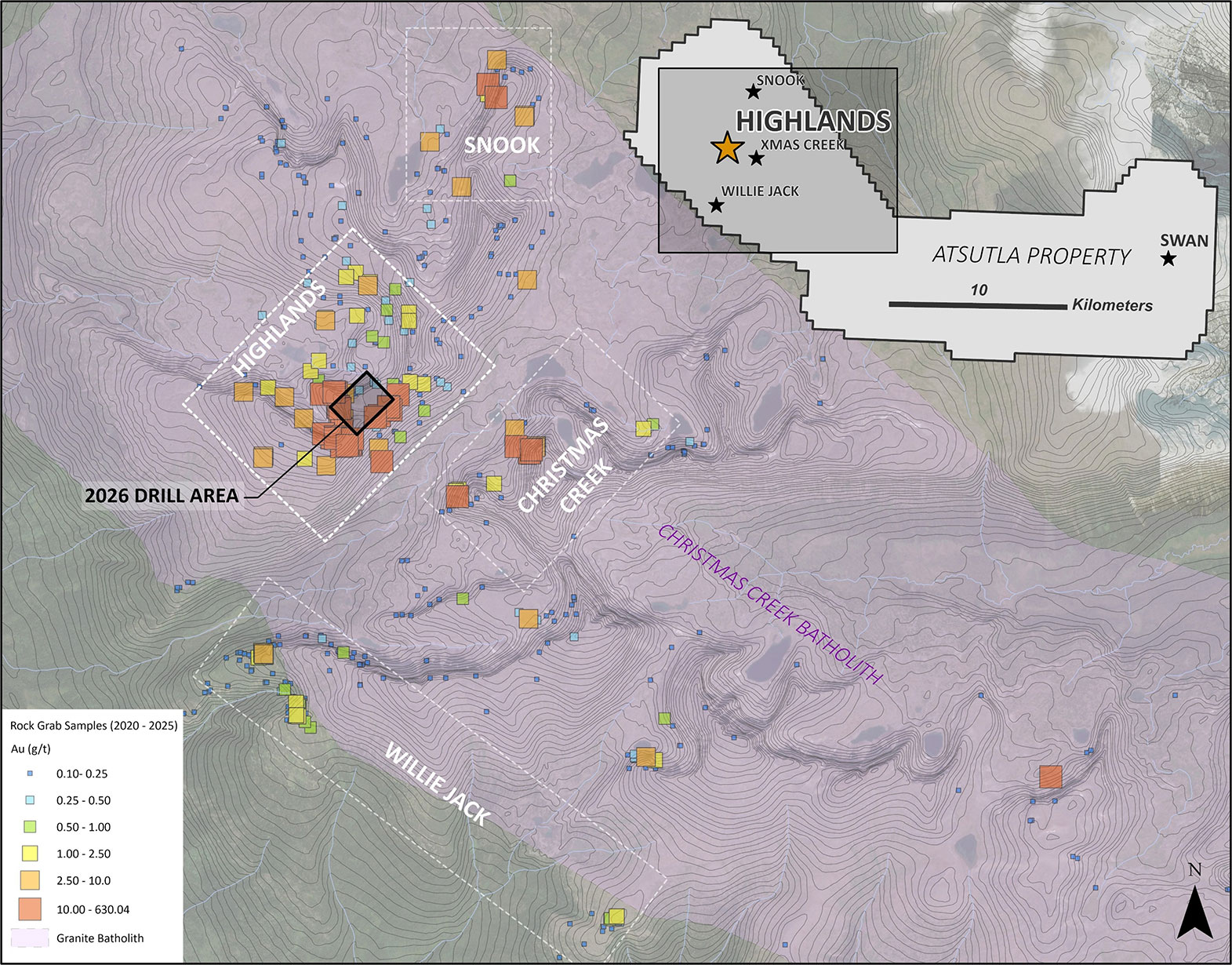
Mineralization at the Highlands Zone is interpreted to be part of a much larger system (Atsutla West), which includes the Christmas Creek and Snook zones. Combined, these zones cover an area of 5.0 km x 4.3 km (Figure 3). Trailbreaker's technical team interprets the shear structure delineated at the Highlands Zone to be continuous with similar auriferous structures identified at the Christmas Creek and Snook Zones.
Beyond the Atsutla West gold system is the Willie Jack Zone, which is located 2.8 km south of Highlands. Unlike the Highlands, Christmas Creek, and Snook zones, Willie Jack is located outside of the Christmas Creek batholith. The zone occurs within Permian Kedahda Formation metasediments, where it lies in contact with the more recently emplaced Jurassic Christmas Creek batholith. The Willie Jack Zone is defined by a 1.25 km-long multi-element anomalous soil trend (Au-As-Ag-Mo-Te) assaying up to 3.77 g/t Au which occurs within a broader 6.5-km-long anomalous gold trend. Prospecting and mapping have revealed the source of the soil anomaly to be a series of southeast-trending gold-bearing quartz veins along the contact with the Christmas Creek batholith, with rock samples assaying up to 9.89 g/t Au. Prospecting along strike 4.7 km to the southeast has revealed quartz veins assaying up to 1.56 g/t Au. An open-ended chip sample across siliceous quartzite in this area yielded 0.35 g/t Au over 6.5m.
The extensive mineralization found in the intrusion-hosted Atsutla West gold system and sediment-hosted Willie Jack Zone supports the district-scale potential of the project and provides numerous drill-ready targets for a planned Phase 2 campaign.
Click Image To View Full Size
Figure 3: Atsutla West gold system. The Willie Jack Zone lies outside of the Christmas Creek batholith.
More about the Atsutla Gold Project
The Atsutla Gold Project is centered over the regional-scale Teslin-Thibert fault system which marks the contact between the Quesnel and Cache Creek terranes. Gold mineralization is associated with the Mesozoic Christmas Creek and Glundebery batholitic intrusions that are the predominant geological units within the property. Since discovery in 2020, Trailbreaker has outlined five significant zones of gold mineralization on the property, across a span of 26 kilometres. These are:
Highlands Zone – A 2.0 km by 1.5 km area in the western Atsutla Gold project region, with quartz veins containing coarse visible gold assaying up to 630 g/t Au and 1,894 g/t Ag. An 883-metre drill program in 2026 yielded 5.02 g/t Au over 2.30 m, including 15.0 g/t Au over 0.70 m.
Christmas Creek Zone – Gold-bearing quartz veins 1.5 km east of the Highlands Zone, with rock samples assaying up to 102 g/t Au and 524 g/t Ag
Snook Zone – High-grade veins 3.5 km northeast of the Highlands Zone, with rock samples assaying up to 53.3 g/t
Willie Jack Zone – 1.25 km long gold-in-soil anomaly with soil samples assaying up to 3.77 g/t Au and rock samples up to 9.9 g/t Au
Swan Zone– A Cu-Au-Ag porphyry target defined by a 1.5 km x 1.5 km multi-element soil geochemical anomaly (Au-Cu-Ag-As-Mo-Sb-Bi)with rock grab samples grading up to 11.7 g/t Au, 212 g/t Ag, and 0.81% Cu. The geochemical anomaly is coincident with a 2.1 km x 1.4 km donut-shaped chargeability high (defined by a 2024 induced polarization survey) as well as a zone of elevated potassium marked by a magnetic low signature indicated from a 2024 airborne magnetic and radiometric survey. Assays remain pending for the 801-metre 2026 drill program.
Quality Assurance/ Quality Control (QA/QC)
Drill core samples were cut in half lengthwise using a core cutting saw at the Atsutla base camp. The resulting half-core samples were driven by Trailbreaker personnel directly to the prep lab of Bureau Veritas Laboratories (Bureau Veritas) in Whitehorse, YT.
Drill core samples were prepared using industry-standard preparation methods, which involved crushing the entire sample until 70% passed through a 2 mm screen. A resulting 250 g split was pulverized to > 85% passing a 75-micron screen (Bureau Veritas prep code PRP70-250).
After preparation, the samples were sent to Bureau Veritas' lab in Vancouver, BC. Samples underwent 37-element analysis (analytical code AQ200). This package involves aqua regia digestion (1:1:1 HNO3:HCl:H2O) of a 0.5-gram split, followed by ICP-ES/MS analysis. Drill core samples also underwent gold fire assay analysis (code FA350-Au). This package uses a 50-gram split, fire assay, and ICP-ES analysis. Samples assaying >10 g/t Au or >100 g/t Ag underwent additional gravimetric analysis (codes FA550-Au and FA550-Ag).
Trailbreaker inserted regular certified reference material (CRM) standard samples, having known metal grades, and blank samples into the sample stream. Additionally, Bureau Veritas performs its own QA/QC procedure and is ISO 17025 certified. Blanks, duplicates, and standard reference materials are sequentially inserted into the client's sample stream to test for contamination, uniformity of element distribution, and analytical accuracy respectively.
Review of all QA/QC data was undertaken by Trailbreaker to ensure that all results are accurate.
About Trailbreaker Resources
Trailbreaker Resources is a mining exploration company focused primarily on mining-friendly British Columbia and Yukon Territory, Canada. Trailbreaker is committed to continuous exploration and research, allowing maintenance of a portfolio of quality mineral properties which in turn provides value for shareholders. The company has an experienced management team with a proven track record as explorers and developers throughout the Yukon Territory, British Columbia, Alaska and Nevada.
ON BEHALF OF THE BOARD
Daithi Mac Gearailt
President and Chief Executive Officer
Carl Schulze, P. Geo., Consulting Geologist with Aurora Geosciences Ltd, is a qualified person as defined by National Instrument 43-101 for Trailbreaker's BC and Yukon exploration projects, and has reviewed and approved the technical information in this release.
Other
For new information about the Company's projects, please visit Trailbreaker's website at TrailbreakerResources.com and sign up to receive news. For further information, follow Trailbreaker's tweets at , use the ‘Contact' section of our website, or contact us at (604) 681-1820 or at info@trailbreakerresources.com.
Neither the TSX Venture Exchange nor its Regulation Services Provider (as that term is defined in the policies of the TSX Venture Exchange) accepts responsibility for the adequacy or accuracy of this release.
Forward-Looking Statements
Statements contained in this news release that are not historical facts are "forward-looking information" or "forward-looking statements" (collectively, "Forward-Looking Information") within the meaning of applicable Canadian securities legislation and the United States Private Securities Litigation Reform Act of 1995. Forward-Looking Information includes, but is not limited to, disclosure regarding possible events, conditions or financial performance that is based on assumptions about future economic conditions and courses of action; expectations regarding future exploration and drilling programs and receipt of related permitting. In certain cases, Forward-Looking Information can be identified by the use of words and phrases such as "anticipates", "expects", "understanding", "has agreed to" or variations of such words and phrases or statements that certain actions, events or results "would", "occur" or "be achieved". Although Trailbreaker has attempted to identify important factors that could affect Trailbreaker and may cause actual actions, events or results to differ materially from those described in Forward-Looking Information, there may be other factors that cause actions, events or results not to be as anticipated, estimated or intended. In making the forward-looking statements in this news release, if any, Trailbreaker has applied several material assumptions, including the assumption that general business and economic conditions will not change in a materially adverse manner. There can be no assurance that Forward-Looking Information will prove to be accurate, as actual results and future events could differ materially from those anticipated in such statements. Accordingly, readers should not place undue reliance on Forward-Looking Information. Except as required by law, Trailbreaker does not assume any obligation to release publicly any revisions to Forward-Looking Information contained in this news release to reflect events or circumstances after the date hereof or to reflect the occurrence of unanticipated events.

Copyright (c) 2026 TheNewswire - All rights reserved.
News Provided by TheNewsWire via QuoteMedia