Investor Insight
Standard Uranium offers leveraged exposure to high-grade uranium discovery through a pipeline of 2026 drill catalysts at its flagship Davidson River project and multiple partner-funded assets. Its project generator model enables sustainable, capital-efficient exploration across a district-scale portfolio while retaining long-term upside through joint-venture option agreements.
Overview
Standard Uranium (TSXV:STND,OTCQB:STTDF,Frankfurt: FWB:9SU0) is a uranium exploration and project generation company focused on advancing high-grade uranium discoveries in the Athabasca Basin, Saskatchewan, one of the world’s most prolific uranium districts. The company combines disciplined, technology-driven exploration with a capital-efficient partnership model that enables multiple projects to advance simultaneously while minimizing dilution.
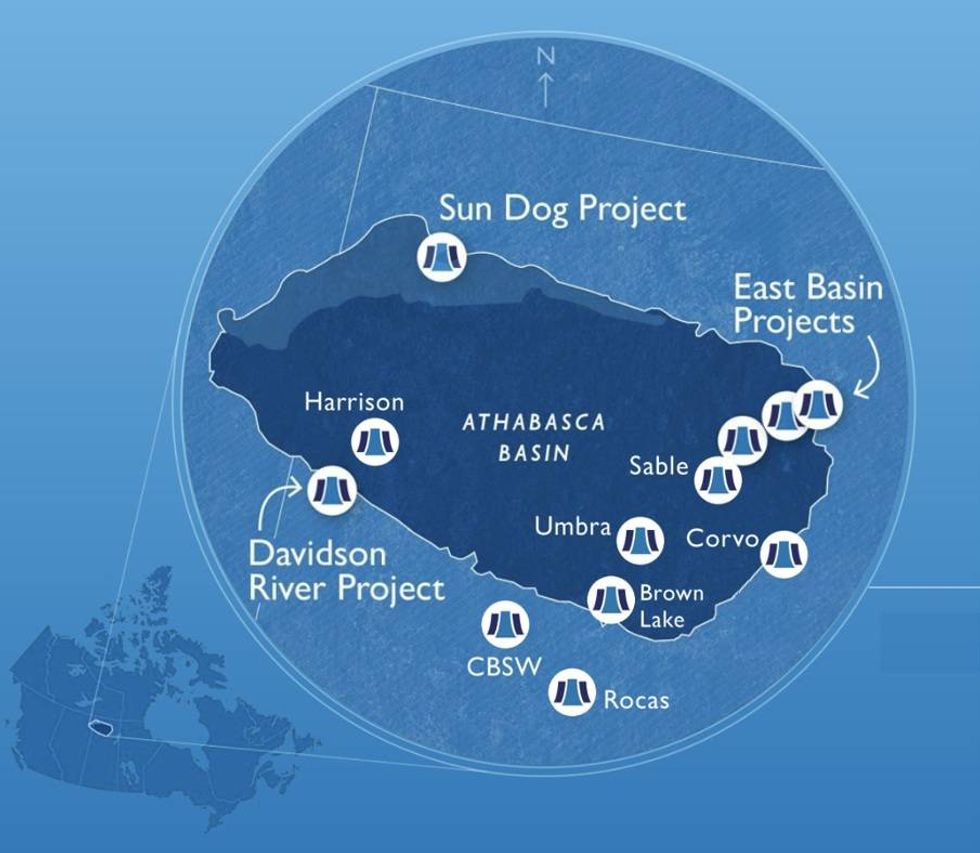
The company’s flagship Davidson River project is located in the southwest Athabasca Basin, a district that hosts over 400 million pounds of uranium in known deposits. Exploration has confirmed the presence of graphitic shear zones, hydrothermal alteration, and redox boundaries—key indicators of fertile uranium systems. The integration of AI-assisted targeting and multiphysics surveys has further refined drill targets and outlined more than 70 kilometres of prospective conductive corridors, with significant portions remaining untested.
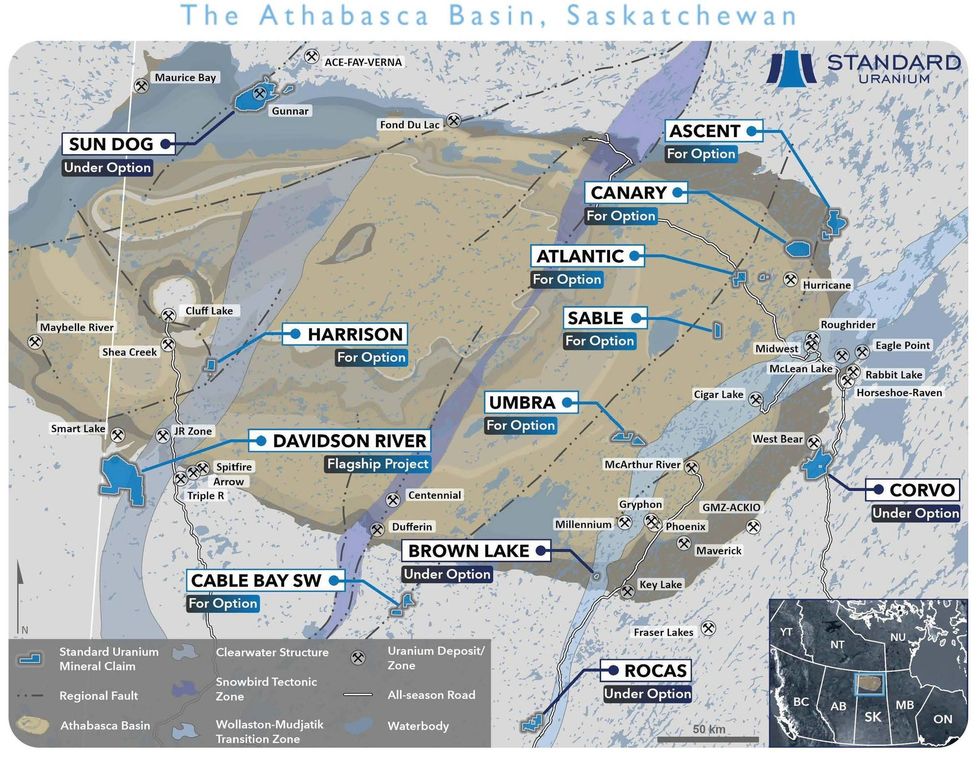
Beyond its flagship asset, Standard Uranium holds a district-scale portfolio of 12 projects totaling over 240,000 acres across both the eastern and western Athabasca Basin. Through joint venture agreements, partners fund exploration programs while the company retains minority ownership and royalty exposure, creating long-term optionality across multiple discovery opportunities.
With planned 2026 drill programs, including first-pass drilling at select projects, and a growing pipeline of partner-funded exploration, Standard Uranium offers a diversified and catalyst-rich platform for uranium discovery in a tier-one jurisdiction.
Company Highlights
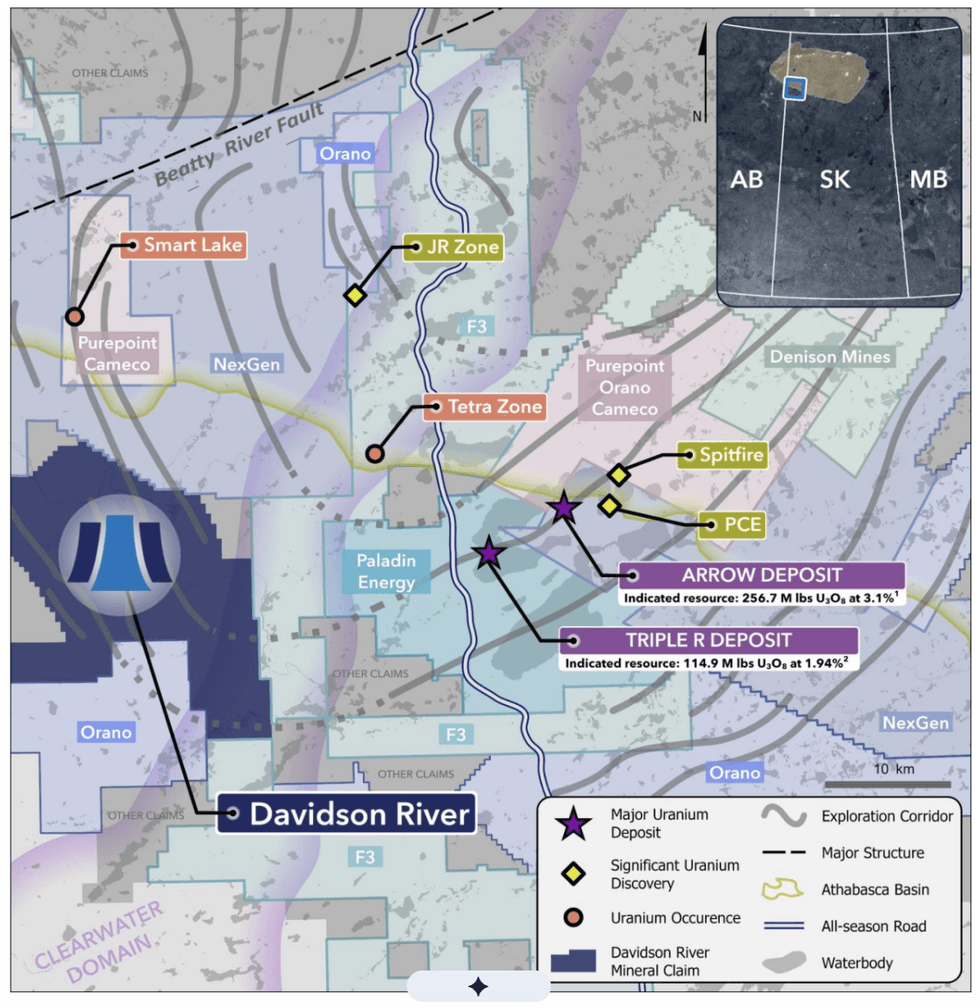
- Flagship Davidson River Project: 30,737 hectares in the southwest Athabasca Basin, along trend from NexGen’s Arrow and Paladin’s Triple R deposits in a district hosting 400M+ lbs of uranium
- District-Scale Portfolio: ~240,670 acres (95,000+ hectares) across 12 projects and 58 mineral claims
- Project Generator Model: Retains minority interests (typically ~25 percent) and 2.5 percent NSR royalties, with partners funding exploration. Terms may vary by deal.
- 2026 Drill Catalysts: Davidson River (8,000–10,000 m) and inaugural programs at Corvo (drilling currently ongoing) and Rocas (drilling currently ongoing)
- Established Exploration Base: 16,561 metres drilled across 39 holes at Davidson River
- Advanced Targeting: AI (GoldSpot) + Fleet Space multiphysics defining 70+ km of prospective trends
- Significant Untested Potential: Large portions of identified conductive corridors remain untested
- High-Grade Surface Results: Up to 3.58 percent U₃O₈ (Sun Dog), 8.10 percent U₃O₈ (Corvo), and ~0.5 percent U₃O₈ (Rocas)
- Strategic Partnerships: Multiple earn-in agreements advancing projects with partner funding
- Macro Exposure: Exposure to growing nuclear energy demand supporting long-term uranium fundamentals
Key Projects
Davidson River Project
The Davidson River project is Standard Uranium’s flagship asset, covering 30,737 hectares across 10 contiguous claims in the southwest Athabasca Basin. The project is located approximately 25 kilometres west of NexGen Energy’s Arrow deposit and along the same regional structural trends that host several major uranium discoveries, within a district containing over 400 million pounds of uranium.
Exploration to date includes 16,561 metres of drilling across 39 holes, which has intersected graphitic shear zones, hydrothermal alteration, and redox boundaries—key indicators of fertile uranium systems. Multiple target corridors have been defined, including the Warrior, Bronco, Thunderbird, and Saint trends, each hosting structural and geophysical characteristics consistent with basement-hosted uranium mineralization.
Recent work integrating AI-driven targeting and Fleet Space multiphysics surveys has outlined more than 70 kilometres of prospective conductive trends, with significant portions remaining untested. These datasets have refined drill targeting ahead of a planned 8,000 to 10,000 metre drill program in 2026, positioning Davidson River as the company’s primary discovery opportunity.
Sun Dog Project
The Sun Dog project is a 19,603-hectare property located in the historic Uranium City district in the northwestern Athabasca Basin. The project hosts multiple mineralized targets associated with structural complexity, graphitic rocks, and hydrothermal alteration—key ingredients for high-grade uranium deposits.
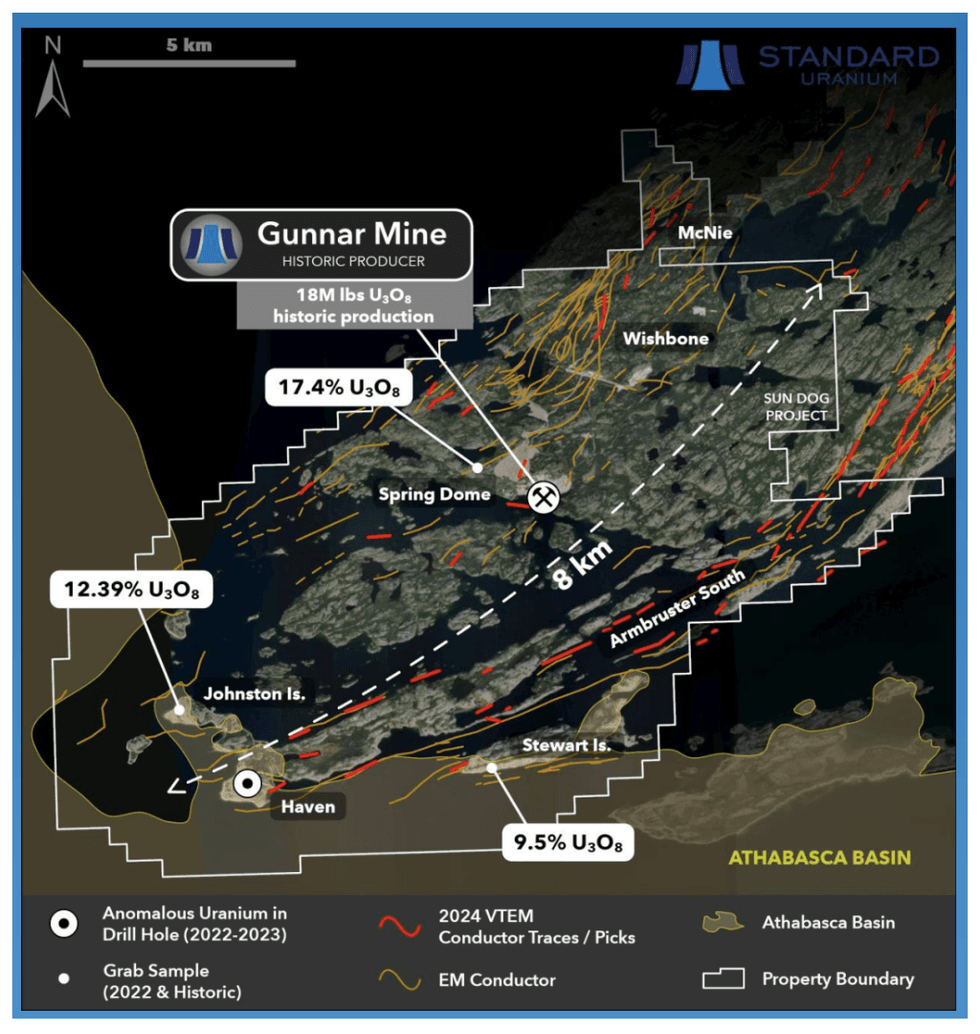
Surface sampling has returned grades of up to 3.58 percent U₃O₈, with additional targets such as Haven, Skye, and Wishbone demonstrating elevated radioactivity and favorable alteration systems. Drilling and geophysical programs have confirmed the presence of graphitic fault zones and widespread hydrothermal alteration, reinforcing the project’s prospectivity for basement-hosted uranium mineralization.
Recent work completed includes an airborne VTEM survey, detailed prospecting and mapping, diamond drilling, and a ground gravity survey as well as subsequent geophysical processing, interpretation and modelling of current and historical survey data. The data advancements made to date have built upon the geological understanding of the Sun Dog Project and have led to several new priority target areas across the property.
Corvo Project (Joint Venture)
The Corvo project spans 12,363hectares in the eastern Athabasca Basin and is characterized by three major northeast-southwest trending conductive corridors extending approximately 29 kilometres. These structural trends are coincident with magnetic lows and electromagnetic conductors, representing favorable settings for uranium mineralization.
Historical drilling has confirmed the presence of uranium mineralization on the property, while more recent work has identified high-grade surface results, including up to 8.10 percent U₃O₈ at the Manhattan showing. Notably, parts of the property, including key surface showings, remain largely untested by modern drilling.
The project is being advanced under a joint venture agreement, with Standard Uranium retaining a minority interest and a 2.5 percent NSR royalty. An inaugural drill program is currently underway for 2026, representing the first modern drill testing of several high-priority targets and a key catalyst for the asset.
Rocas Project (Joint Venture)
The Rocas project covers 4,002 hectares in the southeastern Athabasca Basin and is located within an infrastructure-rich region near the Key Lake uranium operation. The property hosts a 7.5-kilometre conductive corridor associated with magnetic lows and electromagnetic anomalies, indicative of favorable geological conditions for uranium deposition.
Surface exploration has confirmed uranium mineralization over approximately 900 metres of strike length, with historical grab samples returning grades of up to ~0.5 percent U₃O₈. Geophysical surveys, including recent gravity work, have identified potential alteration zones and priority targets consistent with basement-hosted uranium systems.
Rocas has not been drill tested to date and is being advanced through a partner-funded earn-in agreement, with Standard Uranium retaining a minority interest and a 2.5 percent NSR royalty. An inaugural drill program is currently underway for 2026 and will represent the first test of these targets, providing meaningful discovery potential.
Eastern Athabasca Portfolio
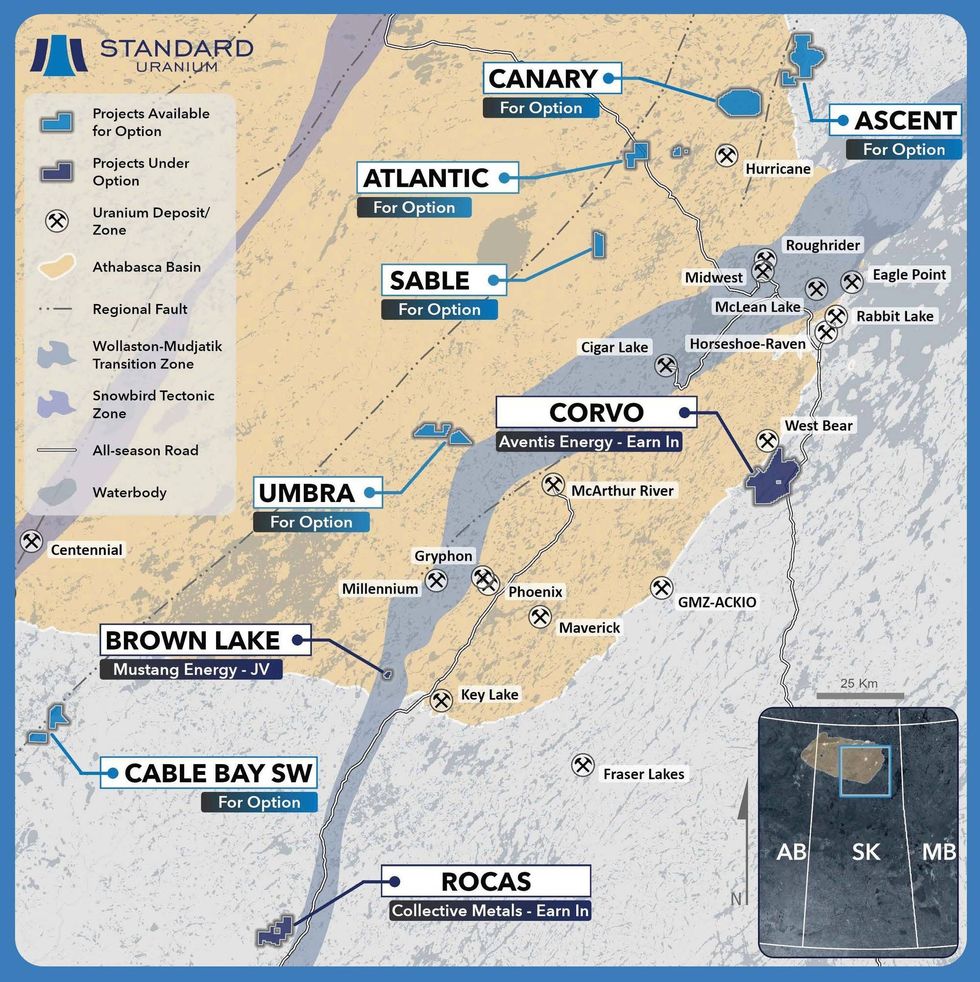
In addition to its core projects, Standard Uranium holds a portfolio of exploration-stage assets across the eastern Athabasca Basin, collectively covering over 43,000 hectares. These include projects such as Ascent, Canary, Atlantic, Cable Bay, Brown Lake, Sable, and Umbra.
These properties are strategically positioned along major uranium trends and in proximity to recent high-grade discoveries, including the Hurricane and Gemini zones. Historical data, geophysical anomalies, and regional geology indicate strong potential for both unconformity-related and basement-hosted uranium mineralization.
The eastern portfolio represents a pipeline of future joint venture opportunities, supporting the company’s project generator model and ensuring continued exploration activity and exposure to new discovery opportunities across the basin.
Management Team
Jon Bey – Chairman, CEO & Director
Jon Bey is a capital markets executive with over two decades of experience in the global resource sector. He has worked across uranium, precious metals, and energy projects in multiple jurisdictions, bringing deep expertise in financing and corporate strategy. Bey has held leadership roles in companies listed on the TSX, TSXV, CSE, and LSE, and is the founder of the Steel Rose Group. His background supports the company’s capital markets strategy and growth initiatives.
Sean Hillacre – President & VP Exploration
Sean Hillacre is an economic geologist with over a decade of experience focused on uranium exploration in the Athabasca Basin. He previously spent five years with NexGen Energy, contributing to the advancement of the Arrow deposit. Hillacre specializes in integrating modern geophysical and data-driven techniques to improve exploration targeting. He leads the design and execution of the company’s exploration programs.
Vivien Chuang – Chief Financial Officer
Vivien Chuang is a Chartered Professional Accountant with more than 15 years of experience in the mining sector. She has served as CFO for several publicly listed companies and brings expertise in financial reporting, governance, and capital markets. In addition to her executive roles, she provides advisory services through VC Consulting. Her experience supports disciplined financial management and compliance.
Neil McCallum – Lead Technical Advisor
Neil McCallum is a professional geologist with over 15 years of experience in mineral exploration, with a focus on uranium systems. He is a project manager at Dahrouge Geological Consulting and has led exploration programs across the Athabasca Basin. McCallum specializes in target generation and geological modeling. His work underpins the company’s data-driven approach to discovery.