The Conversation (0)
Kutcho Copper Corp. (TSXV: KC) (OTCQX: KCCFF) ("Kutcho Copper" or the "Company") reports results from its 2026 exploration program at its feasibility stage, high-grade copper-zinc development project (the "Project") located in Northwest British Columbia.
The 2026 exploration program encompassed two primary objectives:
- A generative program including soil sampling, rock chip sampling and mapping at five greenfield targets: Mira, Eveready, North East Streams and Bow Ridge.
- A 3,830m diamond drilling program (8 drill holes) on three geophysical targets: Esso West, The Gap, and Hamburger including both surface and down drill hole electromagnetic (EM) surveys.
Highlights:
- The Mira target, related to a previously identified buried intrusion, consists of significant mineralization in quartz-carbonate veining hosting tetrahedrite, which is a copper, silver, antimony mineral. 19 of 53 rock samples returned grades greater than 0.5% copper with the top 5 samples returning 1.56% - 6.46% copper, 674g/t - 2,020 g/t silver, 0.91% - 3.39% antimony and 0.04g/t - 0.52 g/t gold.
Soil samples at Mira show a silver-antimony soil anomaly greater than 3 km long and about 1 km wide. The vein samples sit within the halo of the soil anomaly with mineralization hosted in the Sinwa Limestone Formation overlying Kutcho Formation volcanic rocks. Satellite silica alteration data expands the potential footprint of this anomaly to 4.5 km
- Eveready, two kilometers to the east of Mira produced vein hosted mineralization rock grab samples returning 16.35 g/t gold, 1.86% copper and 17 g/t silver. Eveready mineralization may also be related to the buried intrusion, hosted in pyritic ash tuff of the Kutcho Formation rocks.
- North East Streams represents a copper-in-stream-sediment anomaly whose source appears to lie west of the 82 soil samples collected in 2026 and remains to be tested. Historical stream silt samples sampled up to 1,280 ppm copper, and 2,300 ppm zinc.
- Refined project-wide target generation – 34 ranked targets were developed based on conductors, geology, soils, rock samples, drilling and 2026 downhole EM surveys. Currently 6 tier one targets are ready for drill testing in 2027.
- The Gap target, drill hole KC26-300 returned 1.04 metres of 1.48% copper, 0.05% zinc and 18 g/t silver. Additional drill holes at Esso West and Hamburger intersected the Kutcho Time Horizon (rock units that host the current Kutcho deposits) intersecting alteration and pyrite associated with VMS mineralization. The limited 2026 drill program has greatly enhanced targeting methodology through deeper understanding of geological and geophysical data collected and interpreted. Esso West and Hamburger remain high-priority drill targets requiring further drill testing.
Vince Sorace, President & CEO of Kutcho Copper, said: "The 2026 program yielded exciting new discoveries from our generative program, including new epithermal-style targets unrelated to the regional VMS opportunities. Mira represents a large area interpreted to be an epithermal-style system hosted in limestone with veins at surface, related to a deep buried intrusion picked up as a magnetic signature in 2024. Our best grab samples yielded 2,020 g/t silver, 6.46% copper and 3.39% antimony. With A greater than 3 km2 soil anomaly, 80 hectares of outcrop, and a potential 4.5 km2 footprint, this target is a high-priority area for drilling in 2027.
"The Eveready showing (which sits two kilometers to the east of Mira) has vein hosted mineralization in volcanic rocks, with rock grab samples returning 16.35 g/t gold, 1.86% copper, and 17 g/t silver. Early interpretation suggests Eveready and Mira both overlay the footprint of the interpreted buried intrusion, with Eveready representing a potential layer of mineralization underneath the mineralized limestone unit at Mira.
"The 2026 drilling at Esso West, Gap and Hamburger successfully confirmed geophysical techniques, but more importantly helped us gather important geological and relative geophysical data to refine our targeting methodology around our current near resource and regional VMS targets. Esso West and Hamburger remain open to drill testing and remain high-priority target areas. Regional targets have also been re-prioritized given recent data compilations from knowledge gained in the 2026 exploration program, with 34 ranked targets now within the Company's claims position."
Mira – Outcropping Quartz-Carbonate Veining: Silver-Copper-Antimony
The Mira ground was targeted after a buried intrusion was interpreted from modelling of 2023 airborne magnetic data (Figure 1). The 2026 exploration program mapped and collected surface samples from the area overlying this interpreted intrusion. Mira has two outcropping target areas: Blueridge in the west (33.3 hectares) and Ridgecrest in the centre (47.0 hectares). Together they cover more than 80 hectares where quartz-carbonate veins with silver, copper, and antimony minerals show at surface in the Sinwa Limestone host.
The 2026 generative program used several methods in combination: ASTER and WorldView-3 satellite imagery to map nine alteration minerals, a high-resolution LiDAR and photogrammetry drone survey (1.5 cm resolution), geological mapping, and soil and rock sampling. Across the four generative targets the program collected 441 soil samples (336 at Mira) and 58 rock samples (53 at Mira).
At Mira, 12 of 46 outcrop grab samples assayed at or above 300 g/t silver, with the best two samples assayed near 2,000 g/t (Table 1). The grab sampled veins are mostly 0.1 – 0.8 metres wide, with one 1.50m in width.
Ridgecrest lies above the shallowest part of, and Blueridge lies at the western edge of, an interpreted buried intrusion. It is thought that a hydrothermal system related to the intrusion caused alteration and mineralization in overlying fractured and reactive limestone rocks. ASTER satellite images interpreted by PhotoSat in 2026 show silica alteration over both Ridgecrest and Blueridge. The silica alteration continues to the south, indicating potential for veining to continue in the Sinwa Limestone buried under the younger Inklin Formation rocks.
Soil samples at Mira show a silver-antimony soil anomaly greater than 3 km long and about 1 km wide. The vein samples sit within the halo of the soil anomaly with mineralization hosted in the Sinwa Limestone Formation overlying Kutcho Formation volcanic rocks. Satellite silica alteration data expands the potential footprint of this anomaly is still open for potential expansion, as interpreted ASTER silica alteration suggests to 4.5 km2 footprint.
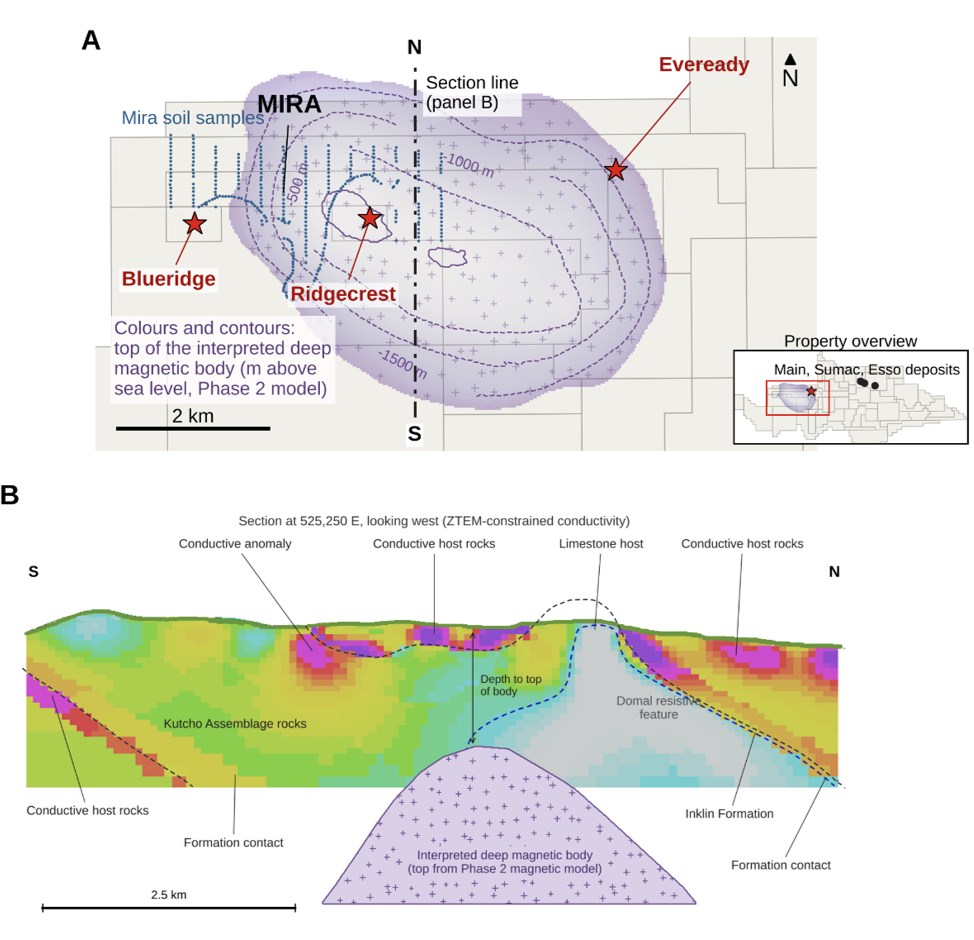
Figure 1: Mira and Eveready relative to the interpreted deep magnetic body. (A) Plan view. Colours and contours show the modelled top of the body in metres above sea level. Blue dots are Mira soil samples, red stars are the Blueridge, Ridgecrest and Eveready occurrences, and the dashed line is the section shown in (B). The inset shows the claims and the Main, Sumac and Esso deposits. (B) Section at 525,250 E looking west through the ZTEM-constrained conductivity model, with the interpreted deep magnetic body below. The body is interpreted from modelling of airbourne magnetic data, so its outline, depth and rock type are uncertain. Source: Mira Geoscience Ltd. magnetic and ZTEM modelling 2024.
To view an enhanced version of this graphic, please visit:
https://images.newsfilecorp.com/files/3735/325218_bfdd3f4ee46fba61_002full.jpg
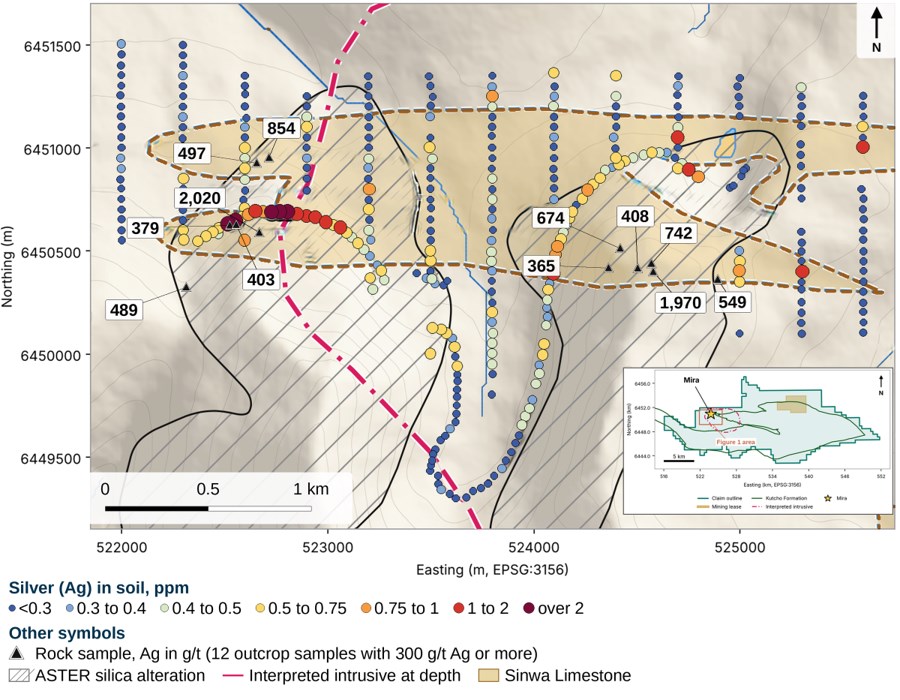
Figure 2: Mira soil samples (336) coloured by silver in ppm. Triangles are the 12 rock samples with 300 g/t silver or more (Table 1), labelled with silver in g/t. Rock samples are selective in nature and are unlikely to be representative of average grades on the property.
To view an enhanced version of this graphic, please visit:
https://images.newsfilecorp.com/files/3735/325218_bfdd3f4ee46fba61_003full.jpg
Table 1: The 12 Significant Mira outcrop rock grab samples
| Sample | Area | East (m) | North (m) | Ag (g/t) | Cu (%) | Sb (%) | Au (g/t) | Vein width (cm) |
| Y101659 | Blueridge | 522670 | 6450588 | 2,020 | 6.46 | 3.39 | 0.23 | 30 |
| Y101751 | Ridgecrest | 524581 | 6450398 | 1,970 | 4.58 | 3.36 | 0.52 | 80 |
| Y101757 | Blueridge | 522717 | 6450951 | 854 | 1.90 | 1.23 | 0.25 | 10 |
| Y101682 | Ridgecrest | 524572 | 6450437 | 742 | 1.56 | 0.94 | 0.05 | unclear |
| Y101680 | Ridgecrest | 524421 | 6450511 | 674 | 1.59 | 0.91 | 0.04 | unclear |
| Y101753 | Ridgecrest | 524894 | 6450360 | 549 | 1.34 | 0.69 | 0.18 | NR |
| Y101756 | Blueridge | 522657 | 6450925 | 497 | 1.27 | 0.82 | 0.13 | 30 |
| Y101657 | Blueridge | 522315 | 6450322 | 489 | 1.13 | 0.65 | 0.12 | NR |
| Y101662 | Ridgecrest | 524506 | 6450415 | 408 | 0.75 | 0.55 | 0.03 | 150 |
| Y101726 | Blueridge | 522558 | 6450626 | 403 | 1.11 | 0.61 | 0.15 | NR |
| Y101725 | Blueridge | 522527 | 6450623 | 379 | 1.13 | 0.71 | 0.04 | 30 |
| Y101681 | Ridgecrest | 524364 | 6450416 | 365 | 0.91 | 0.51 | 0.02 | 75 |
Coordinates are NAD83, UTM zone 9. Vein width is the width logged at the sample spot, not the true width of the mineralization. NR: Not Recorded. Grab samples are selective in nature and are unlikely to be representative of average grades on the property.
Eveready
The Eveready showing is approximately 2 km east of the Mira anomaly, where copper and gold occur in veins in pyritic ash tuff, a volcanic rock. At Eveready a 2026 grab sample (Y101758) assayed 16.35 g/t gold, 1.86% copper and 17 g/t silver. Older grab samples from the same pit have assayed up to 15.4 g/t gold. All nine samples at the Eveready site have at least 0.7% copper (Table 2).
Eveready mineralization is hosted in pyritic ash tuffs of the Kutcho Formation, which sit immediately under the Sinwa Limestone that carries mineralization at Mira. Early interpretation suggests that hydrothermal fluids from the same buried intrusive may have been responsible for mineralization at both occurrences, and the Company envisages an opportunity for a larger and deeper mineralized system occurring in both geological settings. Figure 3 is a simplified north–south section showing how the buried intrusion, the Sinwa Limestone and the Kutcho Formation relate at Ridgecrest and Eveready.
Table 2: Eveready rock grab samples
| Sample | Year | Cu (%) | Au (g/t) | Ag (g/t) |
| 96GBK-06 | 1996 | >10 | 2.26 | 69 |
| 96GBK-09 | 1996 | >10 | 1.32 | 39 |
| A09-28-7 | 2009 | 9.32 | 1.90 | 55 |
| 96GBK-11 | 1996 | 7.03 | 6.18 | 42 |
| 96GBK-12 | 1996 | 7.03 | 2.06 | 45 |
| A09-28-8 | 2009 | 2.73 | 15.4 | 15 |
| 96GBK-10 | 1996 | 2.37 | 0.29 | 15 |
| Y101758 | 2026 | 1.86 | 16.35 | 17 |
| A09-29-9 | 2009 | 0.71 | 1.40 | 11 |
">10" means the result was over the laboratory limit of 10% copper. Grab samples are selective in nature and are unlikely to be representative of average grades on the property
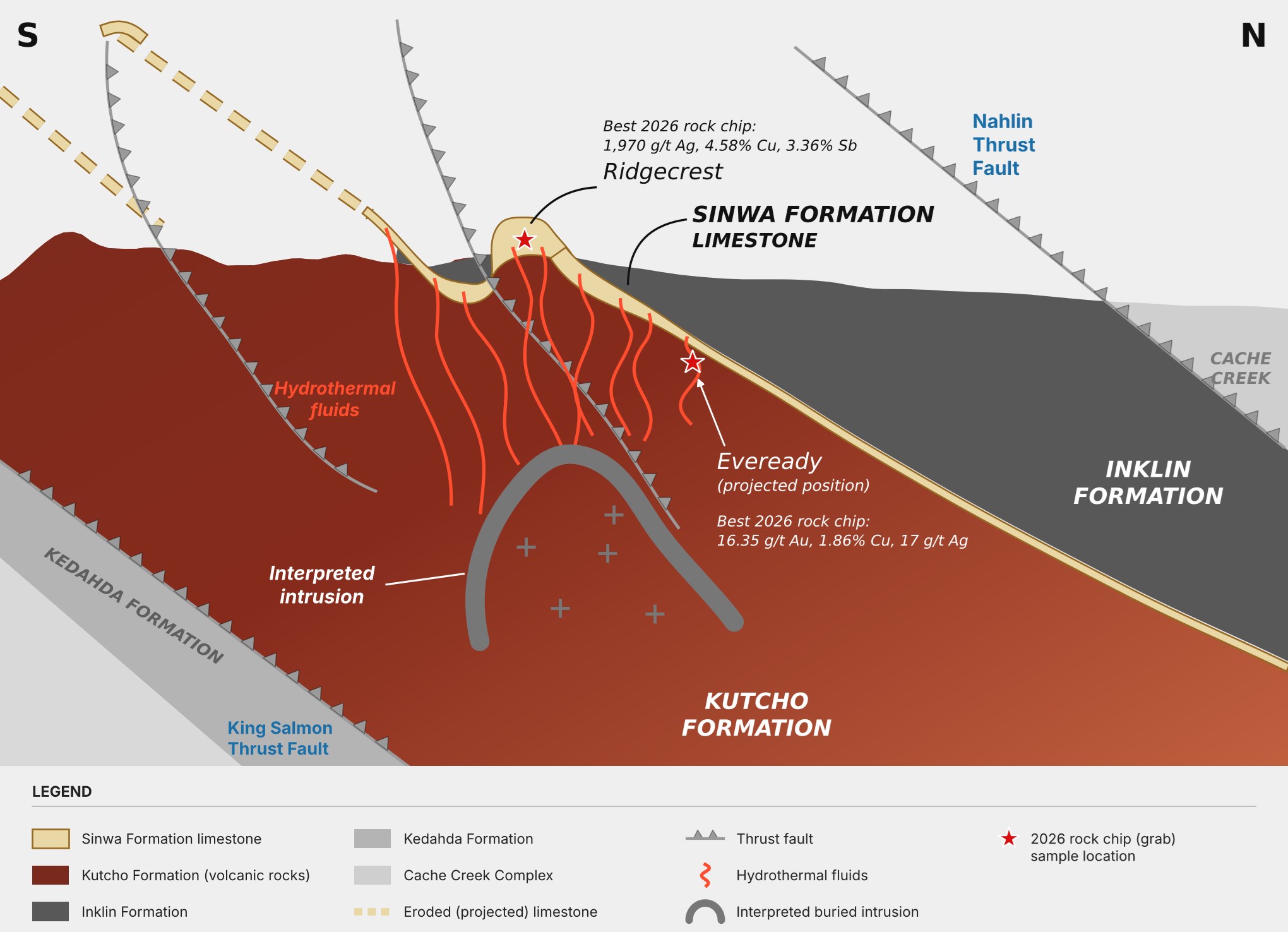
Figure 3: Simplified north–south section through Ridgecrest and Eveready. Schematic, not to scale; Eveready is projected onto the section. The assays shown are the best 2026 rock grab samples, which are selective and unlikely to be representative of average grades. The section line is the same easting as shown in Figure 1.
To view an enhanced version of this graphic, please visit:
https://images.newsfilecorp.com/files/3735/325218_bfdd3f4ee46fba61_004full.jpg
North East Streams
North East Streams: Historical stream silt samples (up to 1,280 ppm copper and 2,300 ppm zinc) and iron-stained outcrop along the Kutcho Fault drew the Company to this area, where 82 soil samples were collected along gridlines across the iron-stained outcrop in 2026. The source of the silt anomalies appears to lie west of the sampled area and remains to be tested. Planned follow-up is infill soil sampling, ground magnetics and moving-loop TEM.
Drilling and Downhole EM – Esso West, the Gap and Hamburger
The Company conducted a limited, eight hole (3,830 m) drill program at three ZTEM targets: Esso West, the Gap and Hamburger (see table 3 below). All eight holes intercepted conductive horizons confirming the ZTEM conductivity prediction.
Table 3: Drill hole locations (all eight 2026 holes, NQ core)
| Hole | Target | East (m) | North (m) | Elev(m) | Azimuth (°) | Dip (°) | Length (m) | DHEM |
| KC26-297 | Esso West | 533767 | 6452376 | 1525.3 | 180.5 | -60 | 389.0 | No |
| KC26-298 | Esso West | 533996 | 6452577 | 1496.7 | 180.1 | -60 | 608.0 | Yes |
| KC26-299 | Esso West | 533713 | 6452511 | 1501.3 | 180.1 | -60 | 514.5 | Yes |
| KC26-300 | Gap | 536153 | 6452376 | 1473.7 | 180.1 | -70 | 395.0 | Yes |
| KC26-301 | Gap | 536845 | 6452435 | 1441.5 | 179.6 | -60 | 398.0 | Yes |
| KC26-302 | Hamburger | 539503 | 6452044 | 1541.2 | 180.0 | -70 | 539.0 | No |
| KC26-303 | Hamburger | 538513 | 6452265 | 1529.6 | 179.8 | -75 | 464.0 | Yes |
| KC26-304 | Esso West | 534627 | 6452752 | 1441.2 | 159.0 | -65 | 522.0 | Yes |
| Total | 3,829.5 |
Coordinates are NAD83, UTM zone 9. Elevation is above sea level at the collar (hole start). DHEM is Downhole EM, holes without DEHM had high waterflow.
Drill hole KC26-300 (the Gap) returned 1.04 m at 1.48% copper, 0.05% zinc and 18.2 g/t silver (Table 4). The holes at The Gap were designed to look for a down dip extension to known VMS mineralization. Significant volumes of the Hamburger conductivity target remain untested. Hole KC26-302 returned 1.31 m of 0.45% Cu (0.48% Cu + Zn) from 492.26 m, but high waterflow prevented downhole EM from being run in the hole, leaving large areas of the target unassessed.
Esso West remains a viable target. Holes KC26-297, 298, 299, and 304 intersected the Kutcho Time Horizon with conductive pyrite and alteration, as ZTEM predicted. In addition, the 2026 review of grade distribution and historical downhole conductivity at the Esso deposit identified a down-plunge extension that is yet to be tested.
During the 2026 field season, Kutcho Copper also conducted combined surface and down hole EM and demonstrated that for shallow (<350 m depth), surface EM can differentiate between copper mineralized and copper unmineralized conductive horizons. The Company will now add ground EM surveys to verify shallow targets and continue downhole EM on all VMS target drillholes.
Drill holes at Esso West and Hamburger cut sericite alteration and pyrite at the Kutcho Time Horizon, relative to the conductivity that ZTEM detected. The ZTEM geophysical technique finds electrically responsive material but not copper itself, while combining surface and downhole EM can better separate copper-bearing from barren conductors in the upper 350 m. For drill targeting, the Company will add ground EM to shallow targets, run downhole EM in all VMS holes, and use the Esso grade-distribution analysis to site new holes at Esso West and Hamburger and to assess regional targets.
Table 4: 2026 significant drill results (all results above 0.5% Cu%+ Zn%)
| Hole (Target) | From (m) | To (m) | Width (m) | Cu (%) | Zn (%) | Ag (g/t) |
| KC26-300 (Gap) | 364.38 | 365.42 | 1.04 | 1.48 | 0.05 | 18.2 |
The result is the length-weighted average of two neighbouring samples. Widths are along the core, not true widths.
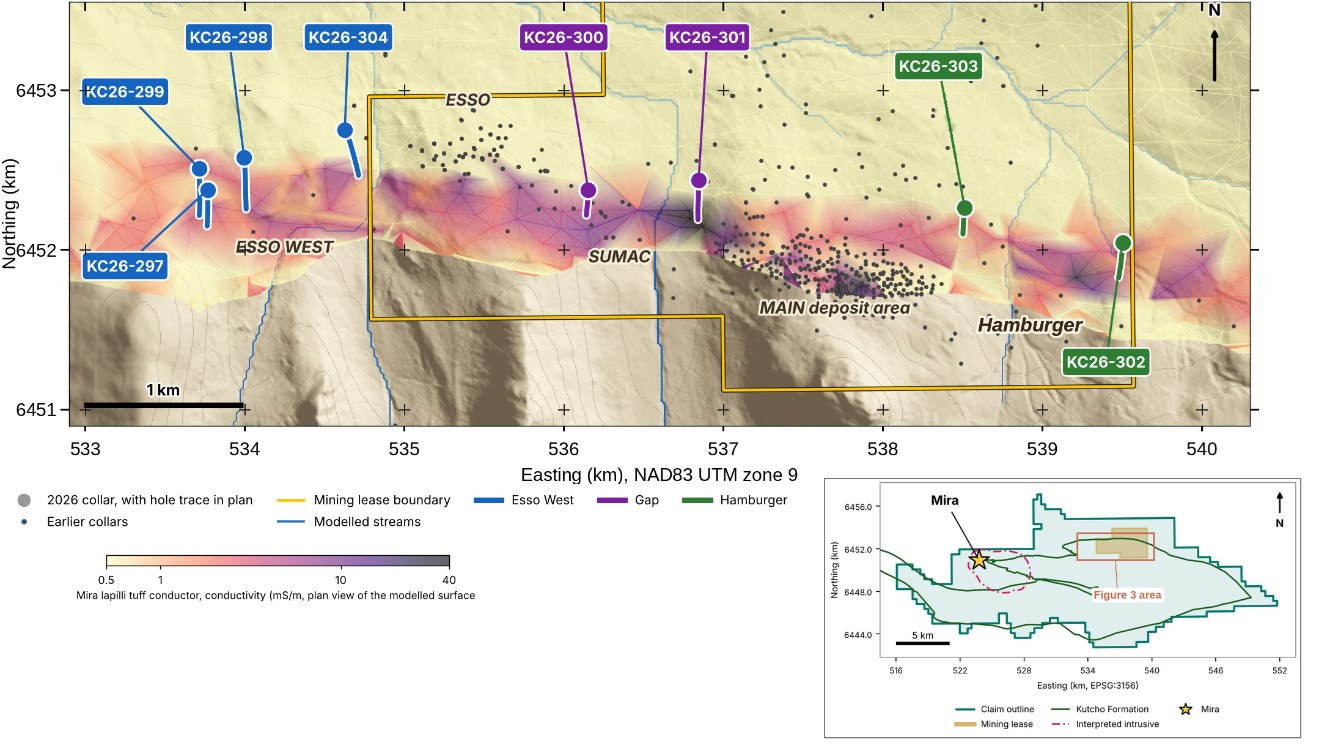
Figure 4: 2026 drill program map (KC26-297 to KC26-304) with ZTEM modelled conductor in the lapilli tuff, coloured by conductivity.
To view an enhanced version of this graphic, please visit:
https://images.newsfilecorp.com/files/3735/325218_bfdd3f4ee46fba61_005full.jpg
Target Generation and Refinement - 34 Ranked Targets
In preparation for the 2027 field season the Company combined 50 candidate targets from six sources into 34 ranked targets (Figure 5). The ranking index is based on the number of different kinds of evidence: conductors, geology, soils, rock samples, drilling and, new in 2026, downhole EM.
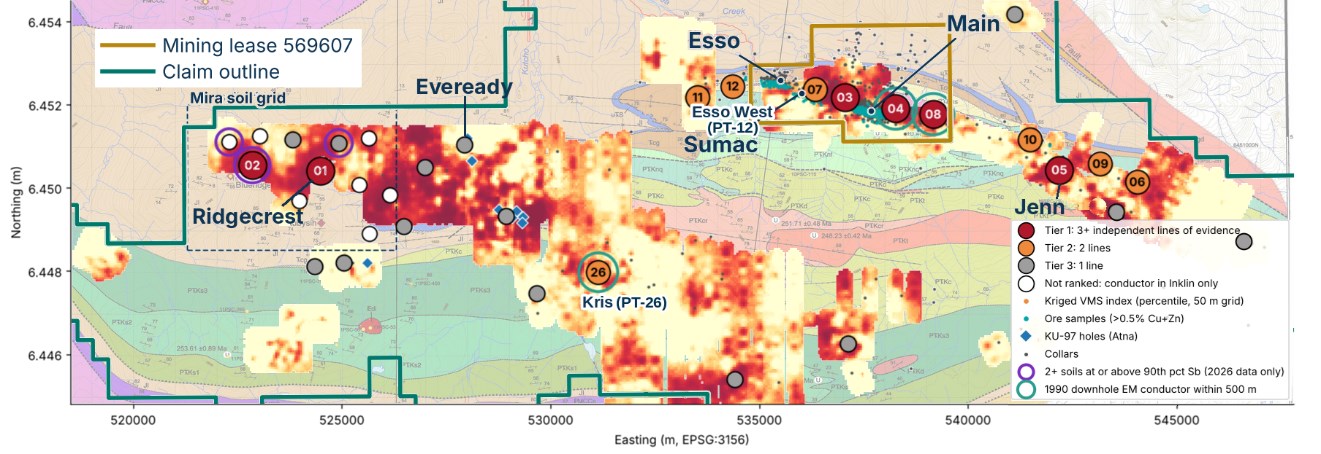
Figure 5: Kutcho project target ranking map (34 targets). Tier 1 has three or more kinds of evidence Tier 2 has two and Tier 3 has one. The map sits over a mathematically calculated multielement soil index and the BC Geological Survey bedrock geology.
To view an enhanced version of this graphic, please visit:
https://images.newsfilecorp.com/files/3735/325218_bfdd3f4ee46fba61_006full.jpg
Six of the 34 targets are Tier 1, meaning each is supported by three or more kinds of evidence: the two Mira targets (Blueridge and Ridgecrest), three targets along the Main trend near the known deposits, and Jenn, east of the Main deposit.
Jenn (a tier 1 target) is east of the Main deposit. It stands out for its conductors, geology, and high grades in soil geochemistry. At Jenn historical drill holes E021, E022, and E107/E108 cut mineralized intervals above 0.5% Cu + Zn. The Company plans a ground EM survey at Jenn to enhance the target prior to drilling.
Qualified Persons
The technical or scientific information in this press release has been reviewed and approved by Andrew Sharp, P. Eng. BC (Lic. No. 47907), FAusIMM, Chief Operating Officer for Kutcho Copper, who serves as a qualified person under the definition of National Instrument 43-101.
Notes:
- Rock samples / Grab Samples: are selective in nature and are unlikely to be representative of average grades on the property.
- Regional and Near Resource Exploration Targets are considered early-stage exploration targets which do not contain any mineral resources as defined by NI 43-101. There has been insufficient exploration to define a mineral resource for the targets disclosed. It is uncertain whether further exploration will result in these targets being delineated as a mineral resource.
- ZTEM is an acronym referring to the Z-Axis Tipper Electromagnetic technique which is a geophysical technique utilizing natural earth currents to image the subsurface three-dimensional distribution of apparent resistivity to depths exceeding one kilometer.
- Downhole EM (DHEM) is an electromagnetic survey run inside a drill hole to detect conductors beside and beyond the hole. Ground EM is the same method run on the surface, and it is less effective at depths of more than about 350 m.
- Electrical Conductivity may indicate the presence of mineralization of economic interest, but also a range of other possibilities, including electrically conductive mudstones, alteration and mineralization such as pyrite.
- Historical Data: This news release includes historical information that has been reviewed by Kutcho's qualified person (QP). Kutcho's review of the historical records and information reasonably substantiate the validity of the information presented in this news release; however, Kutcho cannot directly verify the accuracy of the historical data, including (but not limited to) the procedures used for sample collection and analysis. Therefore, any conclusions or interpretations borne from use of this data should be considered too speculative to suggest that additional exploration will result in mineral resource delineation. Kutcho encourages readers to exercise appropriate caution when evaluating these data and/or results.
- Technical Disclosure: The material scientific and technical information in respect of the Kutcho Project in this news release is, unless otherwise indicated, based upon information contained in the technical report titled "NI 43-101 Feasibility Study Technical Report for the Kutcho Copper Project, British Columbia, Canada" dated effective November 8, 2021 and issued December 22, 2021 (the "FS" or "2021 Feasibility Study"). The 2021 Feasibility Study was prepared in accordance with National Instrument 43-101 – Standards of Disclosure for Mineral Projects ("NI 43-101"). NI 43-101 is a rule developed by the Canadian Securities Administrators that establishes standards for all public disclosure an issuer makes of scientific and technical information concerning mineral projects. These standards differ from the mining property disclosure rules specified in Subpart 1300 of Regulation S-K under the United States Securities Act of 1933 ("Subpart 1300") promulgated by the SEC. Accordingly, information concerning mineral deposits from the 2021 Feasibility Study set forth herein may not be comparable with information made public by companies that report in accordance with U.S. standards.
- Quality Assurance / Quality Control Drill Core: Core was cut in half with a saw. One half was sent to the lab for analysis, and the other half was kept in the core box as a record. Samples were bagged, grouped into sealed bags closed with numbered security tags, and shipped to ALS in Terrace, BC. Core samples were analyzed by four-acid digestion with ICP-MS (method ME-MS61). Copper and zinc above the method limit were re-assayed by ore-grade methods (Cu-OG62 and Zn-OG62). Gold (Au-AA23) and sulphur (S-IR08) were analyzed on selected samples by fire assay and infrared analysis. The Company inserted standard reference materials and blanks into the sample stream at regular intervals. Across the eight holes, 22 standards (OREAS 30a, 625 and 628) and 23 blanks were used. Standards agreed with their certified values. For OREAS 625 and 628, silver, copper, lead and zinc results averaged within 3% of the certified values, and no single result differed by more than 8%. For the low-grade standard OREAS 30a, all results were within three standard deviations except one copper result (50.6 ppm against 44.4 ppm certified), a difference too small to affect the results in this release. Blanks returned very low values (no more than 3.6 ppm Cu, 0.02 ppm Ag and 7 ppm Zn), which shows no sign of contamination.
- Quality Assurance / Quality Control Rock samples: Rock samples were crushed and pulverized at ALS in Terrace, BC, and analyzed at ALS in North Vancouver, BC, using four-acid digestion with ICP-MS (method ME-MS61), with over-limit samples re-assayed by ore-grade methods (Ag-OG62, Cu-OG62, Pb-OG62 and Zn-OG62). Silver above the ore-grade limit of 1,500 g/t in two samples (Y101659 and Y101751) was re-assayed by fire assay with a gravimetric finish (Ag-GRA21). Antimony above the limit in three samples (Y101659, Y101751 and Y101757) was re-assayed by an ore-grade method (ME-OG62). Gold was analyzed by fire assay (Au-AA23). The lab ran its own standards, blanks and duplicates with the rock samples, and its standard results for silver, lead, antimony and sulphur were all within the lab's target ranges. Soil samples: Samples were sent to ALS in North Vancouver, BC, screened to 180 microns, and analyzed by ultra-trace aqua regia digestion with ICP-MS (method ME-MS41). The lab ran its own standards, blanks and duplicates with the soils. Its standard results for silver, lead and zinc were all within the lab's target ranges, and the final certificates were approved for release by the lab. Samples were bagged, sealed with numbered security tags and shipped to the lab.
About Kutcho Copper
Kutcho Copper Corp. is a Canadian resource development company focused on expanding and developing the Kutcho high grade copper-zinc project in northern British Columbia. Committed to social responsibility and the highest environmental standards, the Company recently completed a feasibility study on the Kutcho project and is advancing permitting with the objective of getting to a positive construction decision.
Vince Sorace
President & CEO, Kutcho Copper Corp.
For further information regarding Kutcho Copper Corp., please email info@kutcho.ca or visit our website at www.kutcho.ca. Tel: (778) 357-1249
Cautionary Note Regarding Forward-Looking Statements
Neither the TSX Venture Exchange nor its Regulation Services Provider (as that term is defined in the policies of the TSX Venture Exchange) accepts responsibility for the adequacy or accuracy of this release.
This news release contains certain statements that may be deemed "forward-looking statements" with respect to the Company within the meaning of applicable securities laws. Forward-looking statements are statements that are not historical facts and are generally, but not always, identified by the words "advance", "de-risk", "execute", "incorporate", "accretive", "plans", "compelling", "believes", "intends", "potential", "value opportunities", "upside", variations of these words and similar expressions, or that events or conditions "will", "may", "could", "should" or "would" occur. Although Kutcho Copper believes the expectations expressed in such forward-looking statements are based on reasonable assumptions, such statements are not guarantees of future performance, are subject to risks and uncertainties, and actual results or realities may differ materially from those in the forward-looking statements. Such material risks and uncertainties include, but are not limited to, statements and information related to the Feasibility Study; the funding, timing and results of planned exploration programs; the ability of the Company to upgrade inferred mineral resources to higher categories and, subsequently, to mineral reserves; the outcome of potential optimizations and opportunities identified in the Feasibility Study and subsequently; the Company's ability to raise sufficient capital to fund its obligations under its property agreements going forward, to maintain its mineral tenures and concessions in good standing, to explore and develop the Kutcho project and for general working capital purposes; changes in economic conditions or financial markets; the inherent hazards associates with mineral exploration and mining operations, future prices of copper and other metals, changes in general economic conditions, accuracy of mineral resource and reserve estimates, the ability of the Company to obtain the necessary permits and consents required to explore, drill and develop the Kutcho project and if obtained, to obtain such permits and consents in a timely fashion relative to the Company's plans and business objectives for the projects, including the environmental assessment process; the ability of the Company to conclude agreements with First Nations; the general ability of the Company to monetize its mineral resources; and changes in environmental and other laws or regulations that could have an impact on the Company's operations, compliance with environmental laws and regulations, aboriginal title claims and rights to consultation and accommodation, dependence on key management personnel and general competition in the mining industry. Forward-looking statements are based on the reasonable beliefs, estimates and opinions of the Company's management on the date the statements are made. Except as required by law, the Company undertakes no obligation to update these forward-looking statements in the event that management's beliefs, estimates or opinions, or other factors, should change.

To view the source version of this press release, please visit https://www.newsfilecorp.com/release/325218